June 11, 2026
16 minutes

June 11, 2026
16 minutes
Blockchains are often described as trust machines. They allow people, institutions, and software systems to record transactions, enforce rules, and transfer value without relying on a single central authority.
But blockchains have a basic limitation that is easy to overlook: they do not naturally know what is happening outside their own networks.
A blockchain can verify what has happened on-chain. It can tell whether a wallet sent tokens, whether a smart contract executed, or whether a transaction followed the rules of the protocol. But it cannot, by itself, know the price of bitcoin, the outcome of an election, the weather in Iowa, the interest rate on U.S. Treasuries, the reserve balance of a tokenized fund, or whether a shipment arrived at a warehouse.
That creates a problem.
If smart contracts are supposed to automate agreements, they need reliable information. A lending protocol needs to know the market price of collateral. An insurance contract needs to know whether a qualifying event occurred. A tokenized asset platform may need to know the value of an underlying fund, commodity, or security. A prediction market needs to know the result of the event people were betting on.
This is where oracles come in.
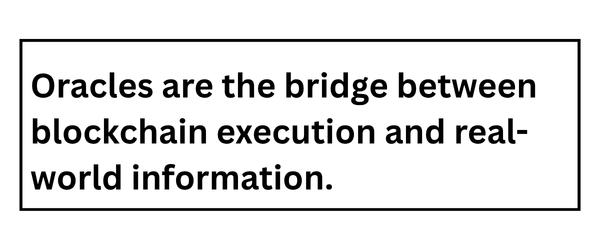
Crypto oracles are systems that bring external data into blockchain environments. They are the bridge between the deterministic world of blockchains and the messy, constantly changing world outside them.
And as Web3 becomes more connected to financial markets, real-world assets, cross-chain applications, and institutional use cases, oracles are becoming one of the most important pieces of blockchain infrastructure.
To understand why oracles matter, we need to understand how blockchains work.
A blockchain is designed to be deterministic. Every node in the network should be able to independently verify the same information and arrive at the same result. This is part of what makes blockchains secure. If the rules are clear and the data is already on-chain, the network can process transactions without needing to trust a central administrator.
But this design creates a wall between the blockchain and the outside world.
A smart contract cannot simply open a browser, check a sports score, call a bank API, read a government database, or pull a price from Bloomberg. If every node independently fetched outside data, they might receive different answers at different times. One node might see a price before another. One API might be temporarily unavailable. One source might be manipulated. The result would be uncertainty, disagreement, and potential failure.
So blockchains solve one problem — internal trust and verification — by deliberately limiting their access to external information.
That tradeoff is powerful, but it also means that blockchains need a trusted way to learn about the world.
That trusted data bridge is the oracle.
A crypto oracle is a system that provides external data to a blockchain or smart contract.
The data can take many forms, including:
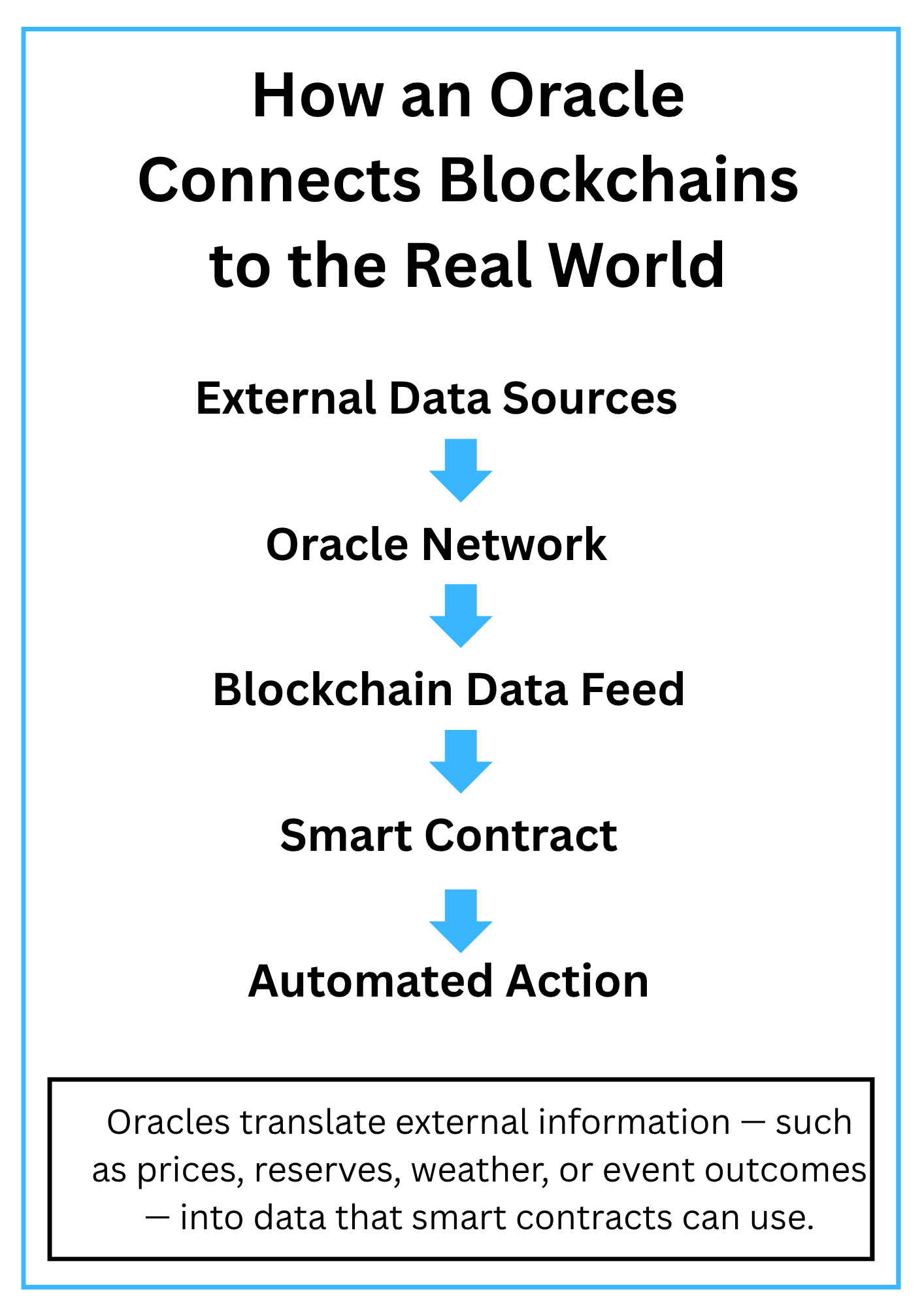
In simple terms, an oracle translates off-chain information into a format that on-chain applications can use.
A smart contract might say: “If ETH falls below a certain price, liquidate this loan.”
But the smart contract does not know the price of ETH by itself. It needs an oracle to provide that price.
Another contract might say: “If this flight is delayed by more than three hours, automatically pay the traveler an insurance claim.”
But the blockchain does not know whether the flight was delayed. It needs an oracle to supply that information.
Oracles are not the applications themselves. They are infrastructure. They are the data layer that allows smart contracts to respond to real-world conditions.
Without oracles, smart contracts would be limited to information already available on-chain.
That would still allow for useful applications. Tokens could move between wallets. Decentralized exchanges could process swaps using on-chain liquidity pools. DAOs could vote on proposals. NFTs could be minted and transferred.
But many of the most economically meaningful blockchain applications require information from beyond the blockchain itself.
DeFi lending protocols need market prices to determine collateral values. Derivatives platforms need reference prices to settle trades. Stablecoins and tokenized assets may need reserve or asset-backing data. Insurance applications need real-world event verification. Prediction markets need outcomes. Cross-chain applications need information from other networks. Real-world asset platforms need data about assets that exist outside the blockchain.
In other words, oracles expand what blockchains can do.
They turn smart contracts from isolated pieces of code into systems that can interact with markets, institutions, physical events, and other digital networks.
That is why oracles are often described as one of the core building blocks of Web3 infrastructure.
At a high level, an oracle system does four things.
First, it sources data from one or more external providers. These providers might include exchanges, market makers, banks, APIs, data vendors, sensors, institutional data providers, or other blockchains.
Second, it validates or filters that data. In a simple design, the oracle might rely on one source. In a more robust design, it may aggregate data from multiple independent sources and discard outliers.
Third, it delivers the data to a blockchain. This usually means publishing the information to an on-chain contract that other smart contracts can read.
Fourth, the consuming smart contract uses that data to execute logic. The contract may update collateral values, settle a trade, trigger a payout, rebalance a position, or change the state of an application.
The basic flow looks like this:
External data source → Oracle network → Blockchain → Smart contract execution
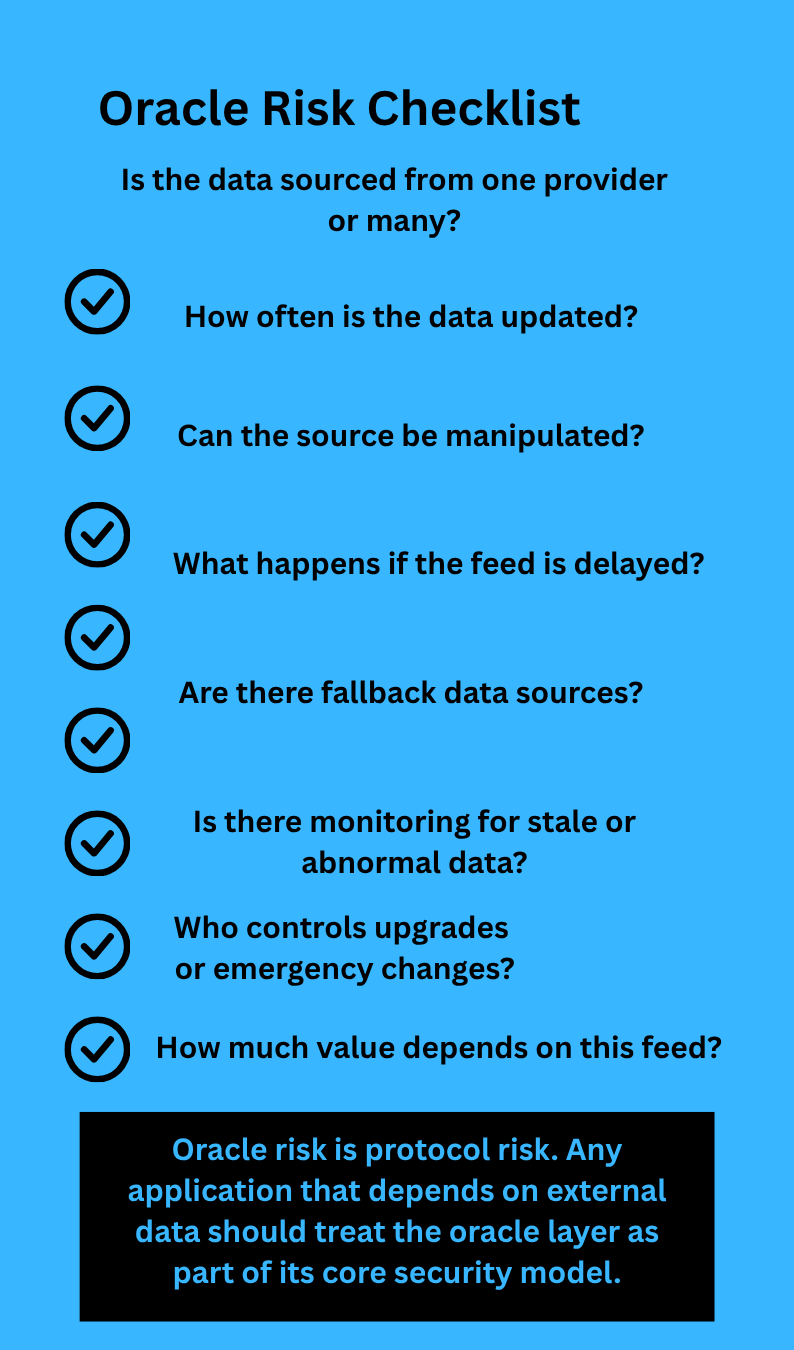
This may sound straightforward, but the design choices are important. Who provides the data? How often is it updated? How is it verified? What happens if different sources disagree? What happens if a source fails? Who pays for updates? Can the oracle itself be manipulated?
These questions are central to oracle design.
One way to classify oracles is by how centralized they are.
A centralized oracle relies on a single data provider or operator. This can be simple, fast, and efficient. But it creates a single point of failure. If the provider is wrong, compromised, delayed, censored, or offline, the smart contract depending on that data may behave incorrectly.
A decentralized oracle attempts to reduce that risk by using multiple nodes, multiple data sources, or both. Instead of trusting one provider, the system aggregates inputs and produces a result that is harder for any single actor to manipulate.
This does not eliminate all risk. Decentralized oracle systems still depend on design choices, incentive structures, data quality, governance, and implementation security. But decentralization can make the oracle layer more resilient.
This matters because smart contracts can control large amounts of value. A bad price feed in a lending protocol can trigger incorrect liquidations. A manipulated data source can distort settlement. A delayed update can create arbitrage opportunities. In financial applications, small data problems can become large losses very quickly.
For that reason, the question is not simply whether an oracle works. The question is whether it is reliable enough for the value and risk of the application using it.
Another important distinction is between push and pull oracle models.
In a push model, the oracle regularly publishes data on-chain. For example, a price feed might update whenever the price changes beyond a certain threshold or after a certain amount of time has passed. This allows smart contracts to read recently published data directly from the blockchain.
The advantage of the push model is availability. The data is already on-chain when the application needs it. The drawback is cost. Publishing data on-chain requires transactions, and frequent updates can become expensive.
In a pull model, data is provided when an application needs it. Instead of continuously pushing every update to the blockchain, the system allows users or applications to request or submit fresh data at the moment of execution.
The advantage of the pull model is efficiency. Applications do not need to pay for constant on-chain updates if they only need data at specific moments. The drawback is that application design becomes more complex, because the data must be delivered and verified as part of the transaction flow.
Neither approach is universally better. The right model depends on the use case.
A high-frequency trading or derivatives application may care deeply about latency. A lending protocol may prioritize reliable updates and conservative risk controls. A real-world asset application may only need periodic valuation or reserve information. An insurance product may need event-based verification rather than continuous data.
The oracle design should fit the application’s risk profile.
The “oracle problem” is one of the most important challenges in blockchain design.
Blockchains can verify on-chain transactions. They can enforce rules written in code. But they cannot inherently verify whether off-chain information is true.
If a smart contract receives bad data, it may execute perfectly according to its code while still producing a bad outcome.
This is the key point: smart contracts are only as reliable as the data they depend on.
If an oracle reports the wrong price, a DeFi protocol may liquidate the wrong users or fail to liquidate risky positions. If an oracle reports the wrong outcome, a prediction market may settle incorrectly. If an oracle misreports reserve data, users may believe an asset is safer than it really is. If an oracle is delayed, traders may exploit the lag.
The oracle problem is not just a technical issue. It is also an economic, governance, and trust issue.
Who decides which data sources are valid? What incentives do data providers have to be honest? What penalties exist for bad behavior? How transparent is the system? Can users monitor the data? What happens during market stress? How does the oracle respond to disputed information?
These questions become more important as blockchains move from speculative trading into areas like tokenized assets, credit, insurance, payments, compliance, and institutional finance.
In traditional finance, data infrastructure is often invisible to the end user. Market data vendors, pricing agents, clearinghouses, auditors, custodians, and regulators all play roles in determining what information institutions rely on.
In Web3, some of those functions are being rebuilt as programmable infrastructure. Oracles are part of that reconstruction.
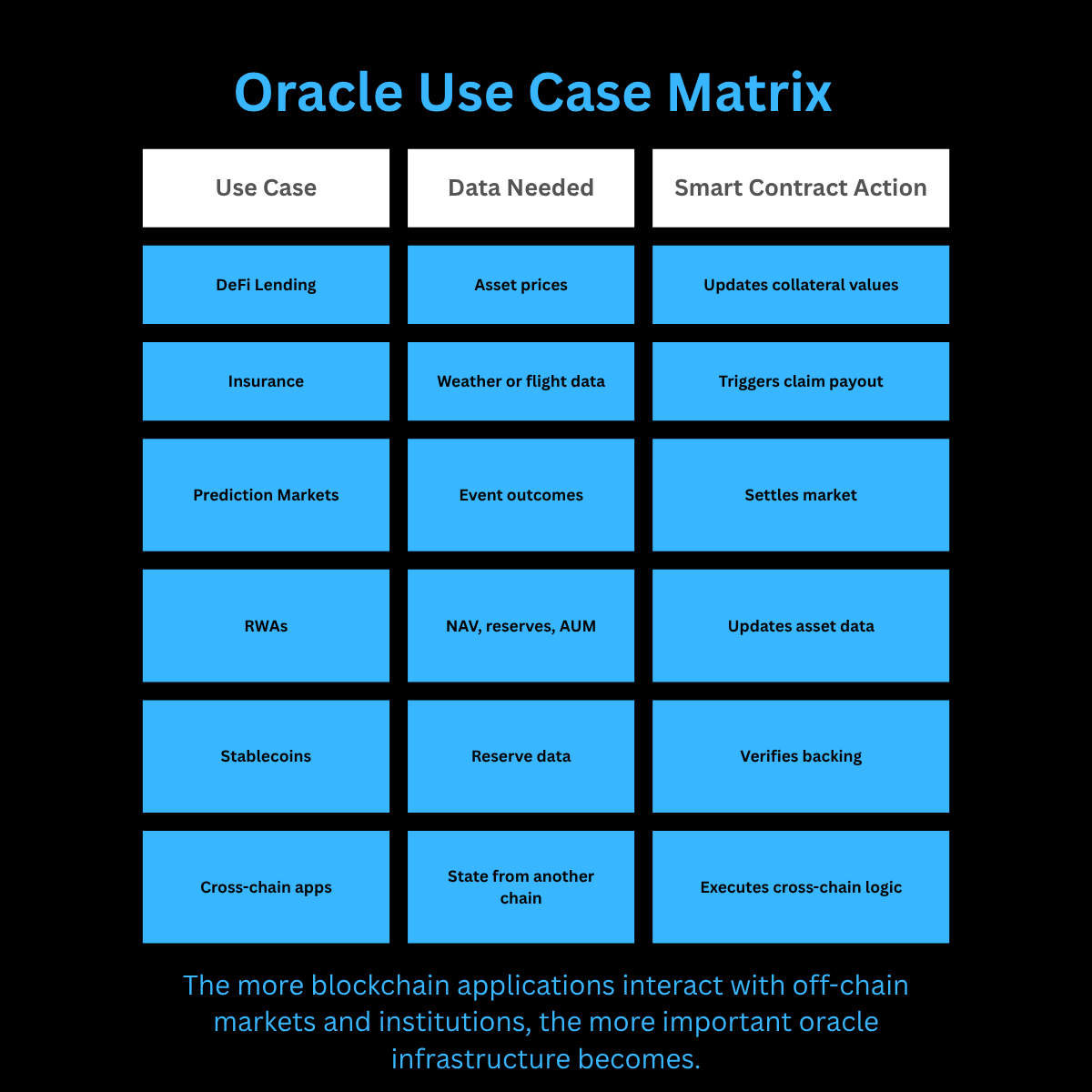
The most common oracle use case is DeFi price data.
Lending protocols need to know the value of collateral. If a user borrows stablecoins against ETH, the protocol needs to know whether the ETH collateral remains sufficient. If the collateral value falls too far, the protocol may liquidate the position to protect lenders.
Decentralized exchanges and derivatives platforms also rely on pricing data. Perpetual futures, options, synthetic assets, structured products, and automated risk engines all need market reference points.
But the use cases are broader than DeFi.
Insurance applications can use oracles to verify weather events, flight delays, crop conditions, or other claim triggers.
Prediction markets use oracles to determine event outcomes.
Real-world asset platforms may use oracles to report NAV, assets under management, reserve balances, or other off-chain financial data.
Stablecoins and wrapped assets can use proof-of-reserve feeds to help users monitor whether issued tokens are backed by corresponding assets.
Gaming applications can use oracles for randomness, event triggers, or external state.
Supply chain applications can use oracles to report shipment status, sensor data, or inventory events.
Cross-chain applications can use oracle-like systems to verify information from one blockchain and make it usable on another.
This is why oracles should not be thought of as a narrow DeFi tool. They are part of the connective tissue between blockchains and the broader economy.
Several oracle networks and designs have emerged, each with different assumptions and strengths.
Chainlink is the best-known decentralized oracle network and is widely used across DeFi and other blockchain applications. Its data feeds are used to bring information such as asset prices, reserve balances, and network status data on-chain. Chainlink has also expanded into areas such as cross-chain interoperability, real-world asset data, proof of reserve, automation, and other off-chain services.
Pyth is another major oracle network, especially focused on financial market data. Its model emphasizes first-party data from institutions such as exchanges, market makers, trading firms, and financial data providers. Pyth is often associated with lower-latency price data and push/pull delivery models across multiple blockchains.
UMA uses an optimistic oracle model. Instead of assuming every piece of data must be continuously published or verified upfront, optimistic systems allow data to be proposed and then challenged if someone disputes it. This can be useful for event-based outcomes, prediction markets, insurance claims, governance actions, and other cases where the correct answer may not be a simple continuously updated price.
API3 takes a different approach by focusing on first-party oracles, where API providers can make their data available directly to blockchain applications rather than relying entirely on third-party intermediaries.
These examples show that “oracle” is not one single design. It is a category of infrastructure with multiple models, each optimized for different use cases.
The key question for builders and institutions is not simply, “Which oracle is best?”
The better question is, “Which oracle design best fits the data, risk, latency, cost, and trust requirements of this application?”
For institutions, oracles matter because they help answer a fundamental question: how can blockchain systems interact with real-world financial infrastructure?
If tokenized assets are going to become a serious part of capital markets, blockchains need reliable data about the assets being tokenized. That may include fund NAV, reserve balances, corporate actions, interest rates, credit data, identity status, compliance restrictions, or settlement information.
If DeFi is going to mature, protocols need robust risk data, market data, volatility data, and liquidation safeguards.
If stablecoins are going to serve as payment infrastructure, users and regulators will care about reserve transparency, auditability, and operational resilience.
If cross-chain finance grows, applications will need secure ways to verify information across multiple networks.
In all of these cases, oracles sit at the boundary between blockchain systems and external reality.
That boundary is where many of the hardest problems in Web3 live.
It is also where much of the institutional opportunity may emerge.
Financial institutions already understand the importance of data infrastructure. They rely on trusted pricing, reference data, compliance checks, risk models, settlement systems, and reporting. What changes in Web3 is that some of this information can become programmable, composable, and available to smart contracts.
Oracles are one of the mechanisms that make that possible.
Oracles are powerful, but they introduce risks.
The first risk is data quality. If the underlying data sources are poor, manipulated, incomplete, or stale, the oracle output may be unreliable.
The second risk is latency. In fast-moving markets, even a short delay can matter. A price update that is seconds or minutes behind the market can create opportunities for arbitrage, liquidations, or unfair execution.
The third risk is manipulation. If an attacker can influence the data source, exploit a thinly traded market, or take advantage of oracle update rules, they may be able to profit at the expense of a protocol.
The fourth risk is governance. Oracle systems may require upgrades, parameter changes, node selection, data source decisions, or emergency responses. Those governance processes need to be transparent and resilient.
The fifth risk is concentration. Even when an application is decentralized at the smart contract layer, it may still depend heavily on one oracle provider or one type of data source. That dependency can become a hidden centralization risk.
For serious builders, oracle risk should be treated as part of protocol risk management. It should not be an afterthought.
Applications that depend on oracles need safeguards. These may include fallback data sources, circuit breakers, price bounds, update frequency checks, monitoring systems, governance controls, audits, and clear disclosure to users.
In traditional finance, data infrastructure is subject to controls, redundancy, and oversight because errors can be expensive. The same principle applies in Web3.
The rise of tokenized real-world assets makes oracles even more important.
When an asset exists entirely on-chain, the blockchain can usually track its ownership and movement. But when a token represents something outside the blockchain — a Treasury bill, a money market fund, a real estate interest, a private credit instrument, a commodity, or a bank deposit — the system needs reliable information about the off-chain asset.
Who owns the underlying asset? What is it worth? Is it still held in custody? Has the fund’s NAV changed? Are there transfer restrictions? Has a compliance status changed? Has a redemption occurred? Has a corporate action taken place?
These are oracle questions.
The more financial assets move on-chain, the more blockchains will need high-quality connections to off-chain data.
This does not mean oracles solve every problem. Legal rights, custody, regulation, disclosure, and enforcement still matter. A tokenized asset is not made trustworthy simply because data is published on-chain.
But oracles can make parts of the system more transparent, programmable, and auditable.
They can help bridge the gap between the legal reality of assets and the technical reality of blockchain networks.
That bridge will be essential if tokenization becomes a meaningful part of global finance.
The easiest way to understand oracles is this:
Blockchains are good at enforcing rules.
Oracles help blockchains know when those rules should apply.
A smart contract can enforce the terms of a loan, but it needs an oracle to know the value of collateral.
A derivatives contract can settle automatically, but it needs an oracle to know the reference price.
An insurance contract can pay out instantly, but it needs an oracle to know whether the insured event happened.
A tokenized fund can exist on-chain, but it needs reliable data about the fund’s off-chain value and reserves.
Without oracles, blockchains remain largely self-contained. With oracles, they can begin to interact with the real world.
Oracles are not the flashiest part of crypto. They do not get the same attention as new tokens, consumer apps, NFTs, or speculative market cycles.
But they are one of the most important layers of the stack.
They make DeFi possible. They support tokenized assets. They help connect blockchains to institutional data. They enable automation based on real-world events. They support cross-chain activity. They turn smart contracts from closed systems into tools that can respond to external reality.
That makes oracles a critical part of the Web3 infrastructure story.
The future of blockchain will not be built only on faster chains, better wallets, or more speculative assets. It will also depend on the quality of the data that flows into these systems.
As crypto matures, the question will not simply be whether blockchains can execute code.
The question will be whether they can execute code based on trustworthy information.
That is the role of oracles.
They are the data bridges that allow blockchains to reach beyond themselves — and they may be one of the reasons Web3 can move from isolated digital networks toward deeper integration with the real economy.
Oracles are not just a technical feature of crypto. They are part of the data infrastructure that determines whether blockchain-based markets can connect safely to the real economy.
For investors, the key point is this: smart contracts can automate financial logic, but they cannot make good decisions without reliable data. That makes oracle networks a critical dependency for DeFi, tokenized real-world assets, stablecoins, cross-chain applications, prediction markets, and future institutional blockchain systems.
The opportunity is large because nearly every serious on-chain financial application needs trusted external information. But the risk is equally important. Poor oracle design can create hidden fragility through bad data, delayed updates, market manipulation, governance weaknesses, or overreliance on a single provider.
As Web3 matures, investors should evaluate oracle infrastructure the same way they would evaluate market data, pricing, custody, clearing, or risk-management systems in traditional finance. The winners are likely to be the networks and data models that combine reliability, transparency, institutional-grade data sources, economic security, and broad developer adoption.
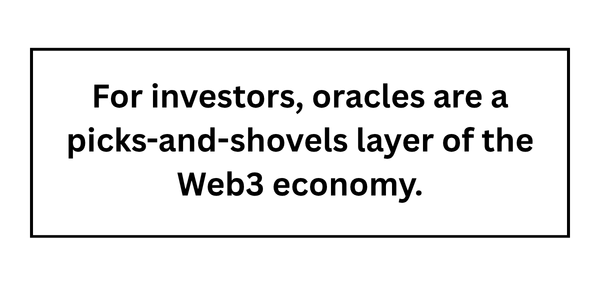
In short: oracles are a picks-and-shovels layer of the Web3 economy. They may not always be visible to end users, but they will be essential if blockchain systems are going to support real financial activity at scale.