April 26, 2026
9 minutes

April 26, 2026
9 minutes

Institutional participation in crypto markets has evolved significantly over the past several years.
What was once viewed primarily as a speculative or experimental asset class has increasingly become integrated into broader conversations surrounding portfolio allocation, market infrastructure, liquidity management, and financial innovation. While institutional involvement in digital assets remains uneven across sectors and jurisdictions, the shift from exploratory interest toward more formalized participation is becoming increasingly visible.
This transition matters for reasons that extend far beyond price appreciation.
Institutional capital changes how markets behave. It affects liquidity, volatility, infrastructure development, market structure, and the relationship between crypto assets and the broader financial system. As larger and more sophisticated participants enter digital asset markets, crypto increasingly becomes connected to macroeconomic conditions, capital flows, and traditional financial infrastructure.
This evolution represents a critical transition in the history of digital assets.
Crypto markets were initially shaped largely by retail participation, speculative enthusiasm, and relatively fragmented infrastructure. Over time, however, institutional participation has introduced new forms of capital, new operational standards, and new market dynamics.
Understanding this transition—from experimentation to allocation—is essential to understanding how crypto markets are evolving into a more mature and interconnected financial ecosystem.
Institutional interest in crypto did not emerge all at once.
In the early stages, participation was relatively limited and highly cautious. Much of the initial institutional activity came from:
For many of these participants, crypto represented a speculative or asymmetric opportunity rather than a strategic portfolio allocation.
Early institutional involvement often focused on:
Infrastructure limitations also constrained broader participation. Institutional custody solutions remained immature, liquidity was fragmented, compliance standards were inconsistent, and many traditional financial firms lacked internal frameworks for handling digital assets operationally.
This period resembled the early institutional adoption phases seen in other emerging asset classes.
Historically, markets such as emerging market debt, commodity ETFs, and even high-yield credit often experienced gradual institutional entry beginning with smaller, higher-risk participants before broader adoption followed. Crypto markets appear to be undergoing a somewhat similar progression.
Over time, however, several developments began reducing barriers to institutional participation:
These changes helped transform crypto from a purely speculative frontier into a market increasingly viewed through the lens of portfolio management and financial infrastructure.
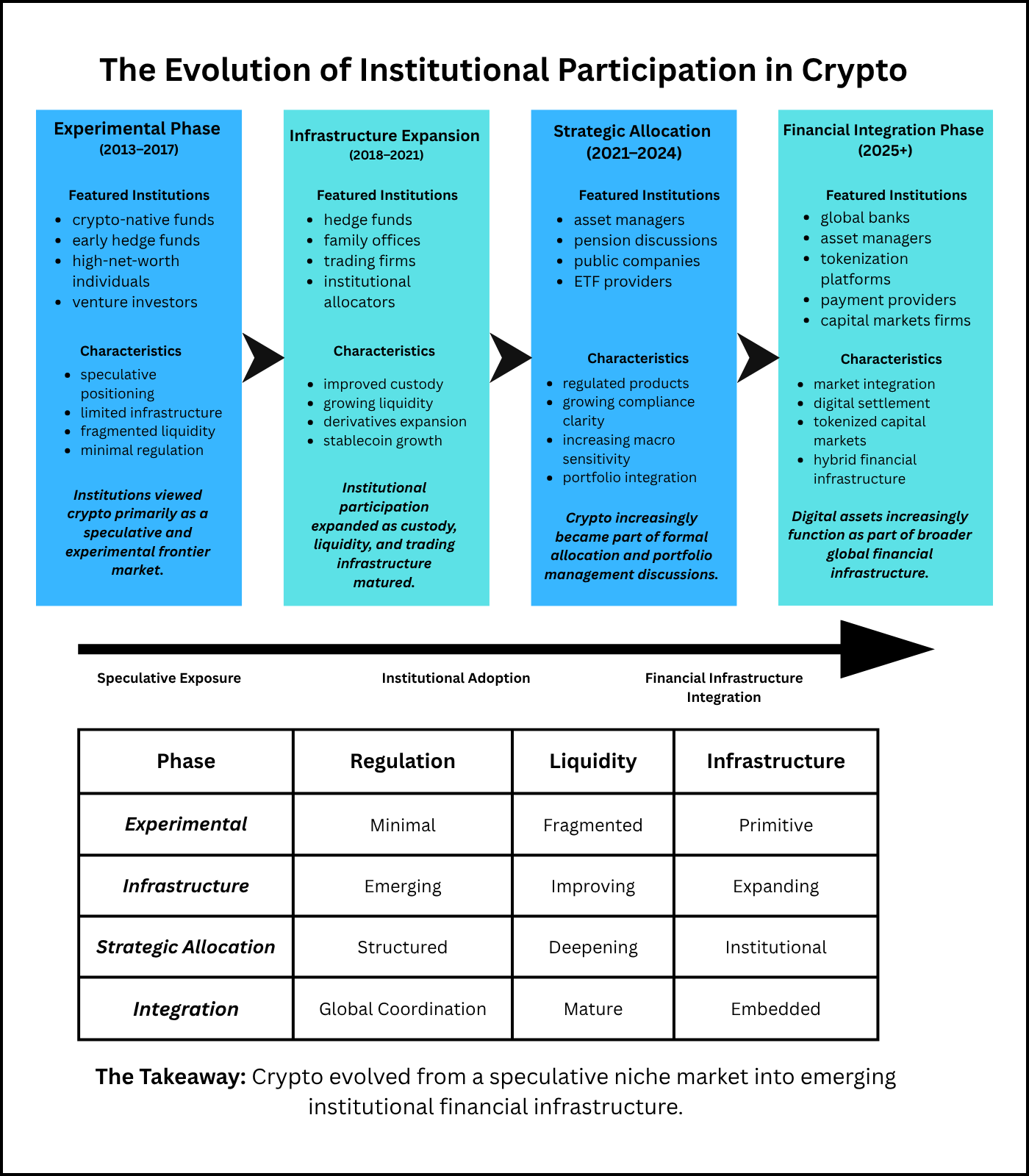
Institutional participation in crypto is often discussed as though it were driven by a single factor. In reality, multiple forces contributed to the shift.
One major driver involved the maturation of market infrastructure itself.
As custody providers, regulated exchanges, and institutional trading platforms improved, operational risks became easier to manage. Firms such as Fidelity Investments and other large financial institutions expanded digital asset custody and infrastructure offerings, helping reduce concerns surrounding asset security and settlement processes.
The growth of stablecoins also played an important role.
Stablecoins increasingly became foundational liquidity infrastructure within crypto markets, facilitating trading, settlement, and capital movement across exchanges and protocols. Their growing adoption demonstrated that blockchain-based payment systems could support large-scale financial activity with increasing efficiency.
At the same time, the rise of tokenized Treasury products and blockchain-based financial infrastructure introduced broader institutional use cases beyond speculative trading.
Another major factor involved portfolio diversification and macroeconomic conditions.
Some institutional investors began viewing Bitcoin and certain digital assets as potential diversifiers, inflation-sensitive assets, or alternative stores of value within broader portfolio strategies. While views differ significantly across institutions, the emergence of these allocation frameworks helped normalize crypto discussions within investment committees and portfolio management conversations.
Exchange-traded products also contributed to this transition.
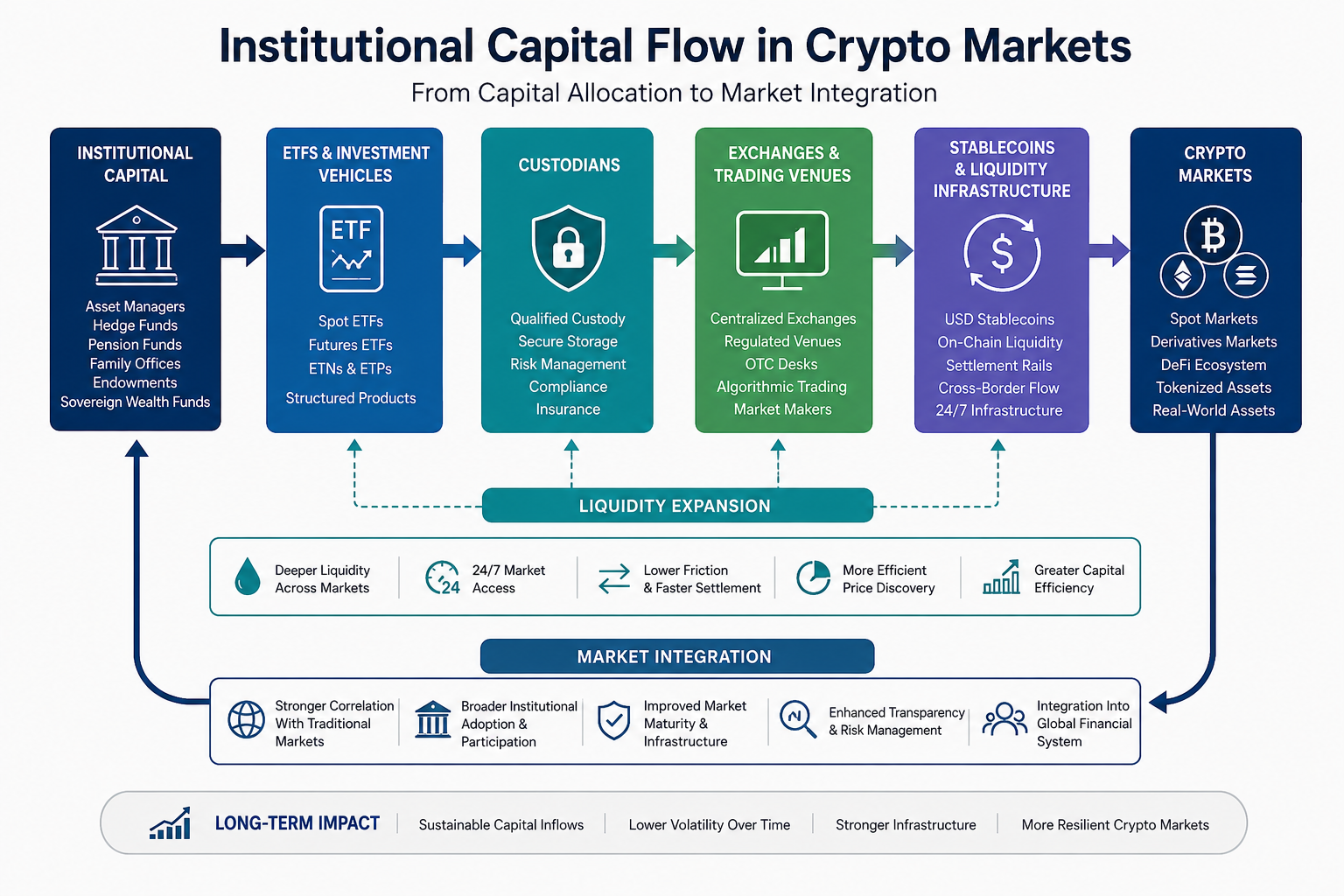
The expansion of crypto-related ETFs and regulated investment vehicles reduced operational complexity for many institutional participants. Instead of directly managing wallets or blockchain infrastructure, firms could gain exposure through more familiar investment structures.
The involvement of firms such as BlackRock further reinforced the perception that digital assets were becoming increasingly integrated into mainstream financial markets.
Importantly, institutions did not enter crypto solely because of ideological interest in decentralization or blockchain technology.
Most institutional participation has been driven by more traditional considerations:
This distinction matters because it increasingly shapes how crypto markets behave.
Institutional capital behaves differently from retail capital.
Retail participation is often more fragmented, sentiment-driven, and reactive to short-term price movements. Institutional capital, by contrast, tends to operate through more structured allocation frameworks, liquidity requirements, and risk management processes.
As institutional participation expands, market structure begins evolving accordingly.
One major effect is the concentration of liquidity.
Institutions generally prefer:
As a result, capital tends to concentrate in major assets such as Bitcoin and Ethereum, while liquidity becomes increasingly centered around large exchanges, ETF products, and institutional trading infrastructure.
This concentration can improve market efficiency in some areas while reducing liquidity across smaller or more speculative sectors of the market.
Institutional participation also increases the importance of derivatives markets.
Futures, options, OTC trading desks, and structured products become increasingly central to price discovery and liquidity management. In many cases, derivatives activity begins influencing spot market behavior more directly than retail trading alone.
This introduces more sophisticated forms of market behavior:
The role of custody infrastructure also becomes increasingly important.
Large institutional firms require secure asset custody, compliance reporting, insurance standards, and operational controls that differ significantly from retail participation. This creates demand for specialized infrastructure providers and regulated financial intermediaries capable of supporting institutional-scale activity.
Over time, these developments push crypto markets toward structures that increasingly resemble broader capital markets infrastructure.
Institutional participation can affect volatility in multiple—and sometimes contradictory—ways.
One common assumption is that institutional capital automatically stabilizes markets. In practice, the effects are more nuanced.
On one hand, larger pools of liquidity can reduce certain forms of short-term volatility. Deeper order books, more sophisticated market makers, and broader participation can improve price efficiency and reduce fragmentation.
On the other hand, institutional positioning can amplify market moves under certain conditions.
Large reallocations of capital, leveraged positioning, ETF inflows and outflows, and macro-driven portfolio adjustments can create significant directional pressure. As crypto markets become more integrated into institutional portfolios, they also become more sensitive to broader market conditions and liquidity cycles.
This changes the nature of volatility itself.
Earlier crypto markets were often dominated by retail speculation, narrative cycles, and internal crypto dynamics. Institutional participation increasingly links crypto volatility to:
The result is a market that becomes less isolated and more interconnected with global financial systems.
In some respects, crypto markets are gradually transitioning from primarily speculative frontier markets into macro-sensitive financial assets operating within broader capital flows.
As institutional participation deepens, crypto markets increasingly become integrated into the larger financial system.
This integration is visible through rising correlations between digital assets and broader macroeconomic conditions.
Crypto markets increasingly respond to:
This reflects a major structural shift.
In crypto’s earlier years, digital assets often behaved somewhat independently from traditional financial systems. Market cycles were driven more heavily by internal crypto adoption trends, retail participation, and ecosystem-specific developments.
Today, however, institutional involvement has strengthened the relationship between crypto and traditional markets.
Large asset managers, hedge funds, and macro investors increasingly evaluate digital assets within broader portfolio frameworks rather than as isolated speculative instruments. As a result, crypto assets may trade more like components of a global liquidity system than entirely independent markets.
This integration has both advantages and tradeoffs.
Greater institutional participation may improve market maturity, liquidity, and infrastructure quality. At the same time, it may reduce some of the independence that originally differentiated crypto markets from traditional financial systems.
As crypto becomes more connected to institutional capital flows, it also becomes more exposed to broader macroeconomic cycles and systemic financial conditions.
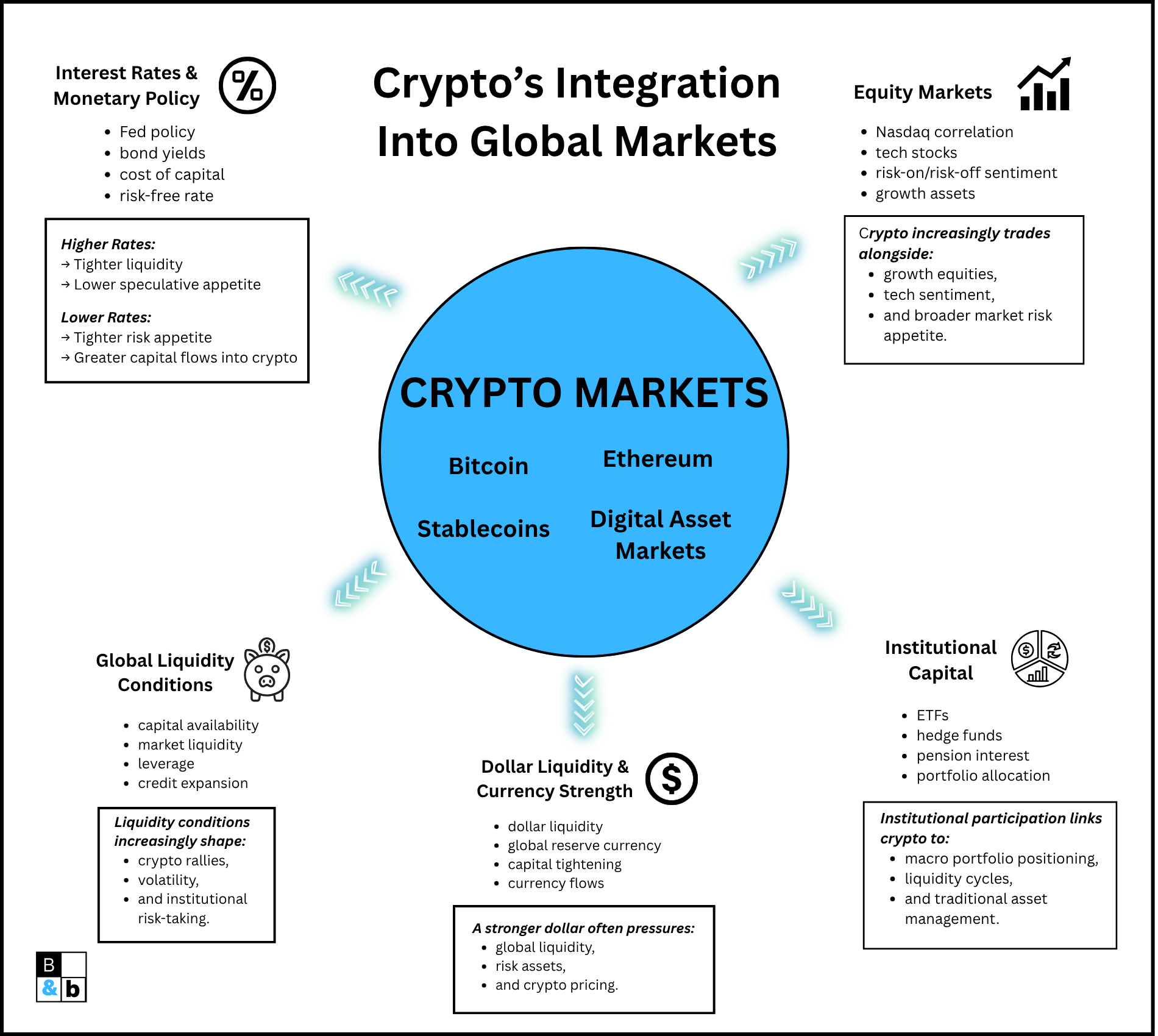
Institutional participation does not simply add capital to crypto markets—it changes the character of the market itself.
As institutional influence expands, market priorities often shift toward:
This can reduce certain forms of speculative instability while simultaneously increasing the importance of macroeconomic positioning and financial infrastructure.
Over time, crypto markets may become:
This process also affects which sectors of crypto attract sustained institutional attention.
Institutions generally prioritize areas with:
As a result, sectors such as:
may attract more long-term institutional participation than highly speculative or experimental sectors of the market.
In many respects, this represents the financialization of crypto.
Digital assets increasingly become part of broader global capital systems rather than operating as a fully separate alternative financial ecosystem.
Institutional participation in crypto is likely to continue expanding gradually, though not necessarily in a straight line.
Market cycles, regulatory developments, macroeconomic conditions, and infrastructure improvements will all influence the pace and structure of adoption. Periods of rapid growth may still be followed by contractions and reassessments.
However, the broader direction appears increasingly clear:
crypto markets are becoming more integrated into institutional financial systems.
This evolution may lead to:
At the same time, the nature of crypto markets may continue changing as institutional participation deepens.
The next phase of the industry may be defined less by speculative experimentation and more by the gradual integration of digital assets into global financial infrastructure:
The long-term significance of institutional flows may therefore extend beyond crypto prices alone.
They may ultimately help shape the broader evolution of digital finance itself.
Crypto markets are undergoing a major structural transition.
What began largely as a retail-driven and experimental ecosystem is increasingly evolving into a market influenced by institutional capital, macroeconomic conditions, and broader financial infrastructure.
This shift does not eliminate volatility, speculation, or uncertainty. But it does change how markets function, how liquidity moves, and how digital assets interact with the global financial system.
Institutional participation is reshaping crypto markets in subtle but increasingly important ways.
Understanding how this capital behaves—and how it changes market structure—offers a clearer view of where the next phase of digital finance may be headed.


.png)