April 26, 2026
3 minutes

April 26, 2026
3 minutes

When people think about crypto, they often focus on assets—tokens, prices, and markets. But beneath every transaction, protocol, and application is a deeper layer that makes it all possible: blockchain infrastructure.
This infrastructure is the foundation of the entire ecosystem. It determines how transactions are processed, how data is stored, and how scalable, secure, and efficient a blockchain network can be.
Understanding this stack is essential to understanding how crypto actually works.
Blockchain infrastructure refers to the underlying systems and components that enable blockchain networks to operate.
Rather than being a single layer, it is a stack of interconnected parts that handle everything from transaction validation to data availability and network communication.
At a high level, this infrastructure is responsible for:
Unlike traditional systems, this infrastructure is often decentralized, meaning no single entity controls it.
To understand how blockchain infrastructure works, it helps to think of it as a layered system.
At the base are Layer 1 blockchains, which handle core functions like transaction processing and security. These are the foundational networks where transactions are finalized.
Built on top of these are Layer 2 solutions, which aim to improve scalability by processing transactions off the main chain while still relying on it for security.
Above that are supporting components—such as nodes, validators, and RPC providers—that ensure the network runs smoothly and remains accessible.
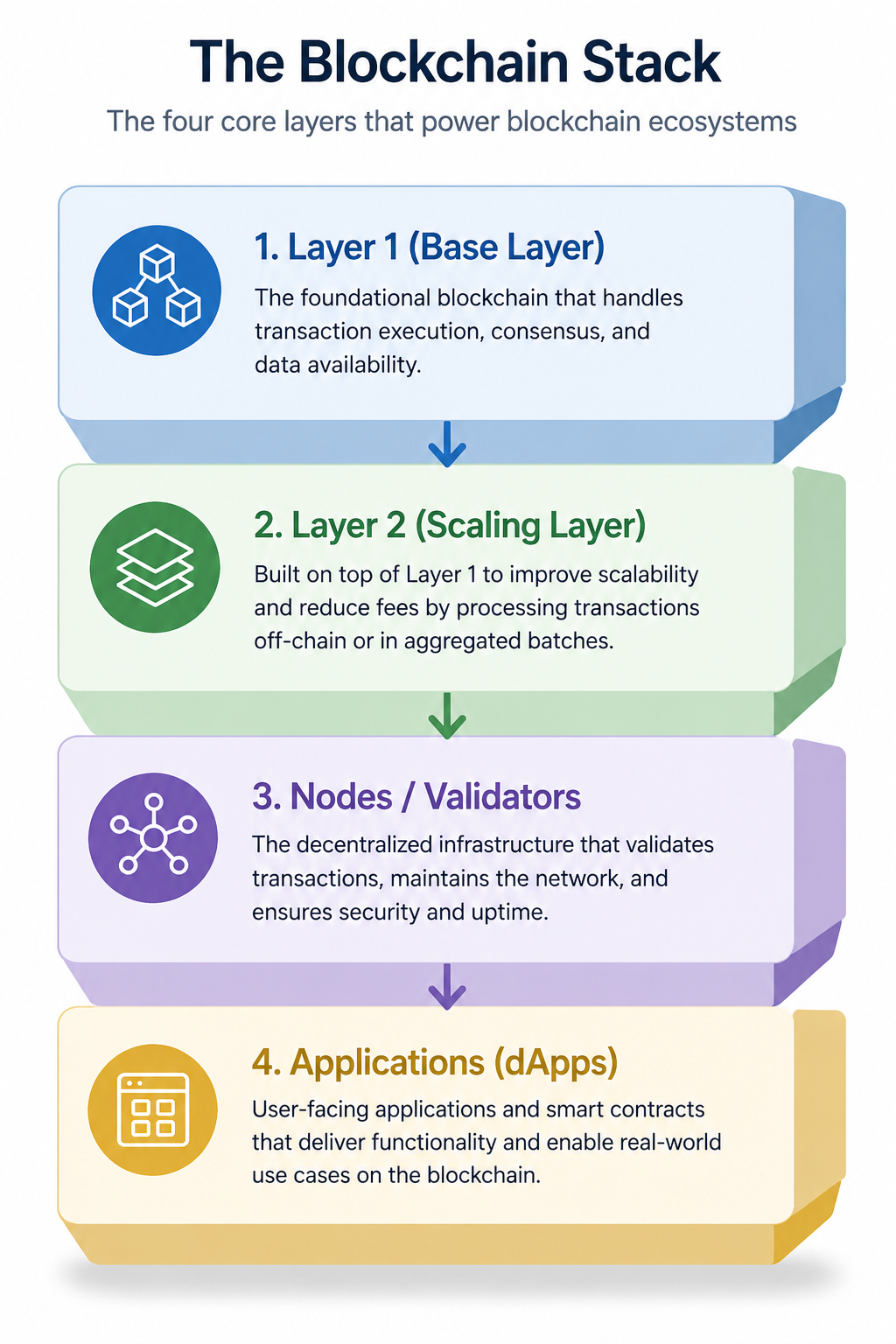
At the core of any blockchain network are nodes—computers that maintain and share copies of the blockchain.
Some nodes take on additional responsibilities as validators. These participants verify transactions, propose new blocks, and help maintain consensus across the network.
Their role is critical. Without them, the network cannot function reliably or securely.
In decentralized systems, this responsibility is distributed across many participants, reducing reliance on any single point of failure.
Beyond transaction processing, blockchains must also ensure that data is accessible and verifiable across the network.
This is where data availability layers and communication protocols come in. They ensure that transaction data is:
As blockchain usage grows, these layers are becoming increasingly important, particularly in systems that separate execution from data storage.
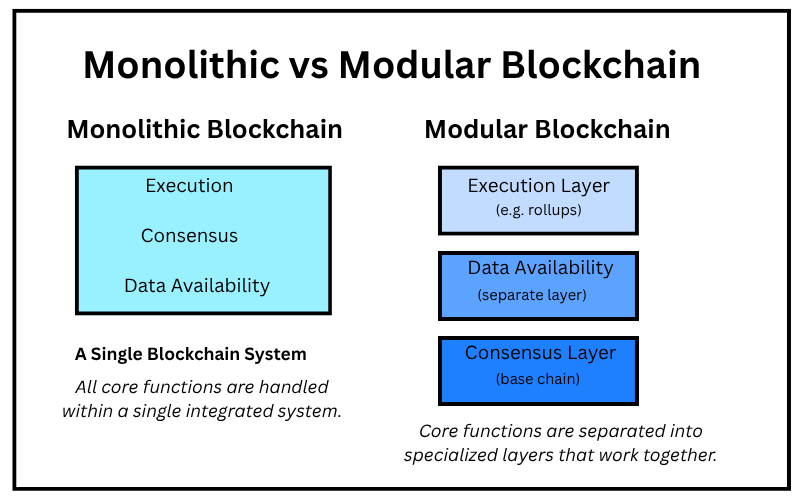
A key shift in blockchain infrastructure is the move from monolithic to modular design.
In a monolithic blockchain, all core functions—execution, consensus, and data availability—are handled within a single system.
In a modular architecture, these functions are separated across different layers or networks. This allows each component to specialize, improving scalability and flexibility.
This shift is shaping how new blockchain systems are designed and how existing ones evolve.
Blockchain infrastructure is not just a technical detail—it directly impacts how the ecosystem evolves.
It determines:
It also shapes what kinds of applications can be built, from simple transfers to complex financial systems.
Every transaction, application, and protocol in crypto depends on infrastructure that most users never see.
Understanding this foundation provides a clearer view of both the capabilities and limitations of blockchain technology.