April 26, 2026
4 minutes

April 26, 2026
4 minutes

Crypto markets never close. They operate across hundreds of platforms, span multiple jurisdictions, and process billions in daily trading volume. Yet despite this constant activity, the mechanics behind how trades actually happen are often overlooked.
To understand price movements, volatility, or even risk in crypto, you first need to understand market structure—the system that connects buyers, sellers, and liquidity.
At its core, market structure refers to the underlying framework that makes trading possible. This includes the venues where trades occur, the participants who facilitate them, and the mechanisms that determine pricing.
In crypto, this structure is fundamentally different from traditional finance. Instead of being centralized and tightly coordinated, it is:
This creates both opportunities and inefficiencies that shape how the market behaves.
Exchanges are where buyers and sellers meet, but not all exchanges function the same way. Broadly, crypto trading takes place across two types of venues: centralized and decentralized.
Centralized exchanges (CEXs) operate similarly to traditional financial platforms. They manage order books, match buyers and sellers, and hold user assets in custody. Their strength lies in efficiency—deep liquidity, fast execution, and a familiar trading experience.
Decentralized exchanges (DEXs), by contrast, run on smart contracts. Instead of matching orders directly, they rely on liquidity pools and algorithmic pricing. This allows users to trade directly from their wallets, without intermediaries.
Each model comes with trade-offs. Centralized platforms tend to offer tighter spreads and deeper liquidity, while decentralized platforms prioritize transparency and self-custody. Increasingly, both systems coexist and interact, forming a hybrid market structure.
Liquidity is one of the most important—and misunderstood—concepts in crypto markets.
At a basic level, liquidity describes how easily an asset can be bought or sold without significantly affecting its price. But in practice, it determines how stable, efficient, and reliable a market actually is.
When liquidity is strong, markets tend to feel smooth and predictable. Trades execute quickly, price movements are more gradual, and large orders can be absorbed without disruption. When liquidity is weak, the opposite happens—prices become more volatile, execution worsens, and small imbalances can trigger large moves.
In practical terms, strong liquidity leads to:
Behind most liquid markets are market makers—firms or protocols that continuously provide buy and sell quotes.
Their role is not to predict the market, but to facilitate it. By standing ready to trade on both sides, they reduce friction and ensure that participants can enter and exit positions efficiently.
In centralized markets, these are typically professional trading firms using advanced strategies and infrastructure. In decentralized finance, liquidity is often provided by users who deposit assets into pools, enabling automated trading through protocols.
Regardless of the model, the function is the same: without consistent liquidity provision, markets become thin and unstable very quickly.
The way prices are formed differs depending on the trading system.
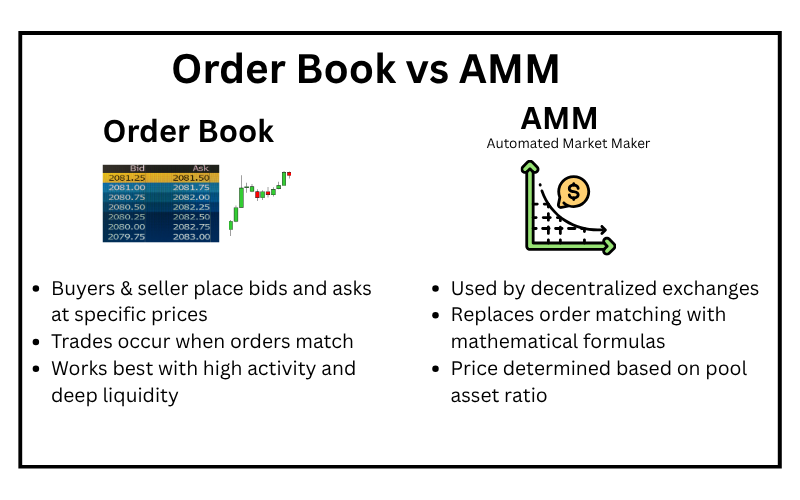
In traditional order book models, buyers and sellers place bids and asks at specific prices. Trades occur when these orders match, and the market price adjusts accordingly. This system works best in environments with high activity and deep liquidity.
Automated market makers (AMMs), used by decentralized exchanges, replace order matching with mathematical formulas. Prices are determined based on the ratio of assets in a liquidity pool, allowing trades to occur even without a direct counterparty.
Both systems have strengths and limitations. Order books offer precision and efficiency, while AMMs enable accessibility and continuous liquidity.
One of the most important characteristics of crypto market structure is fragmentation.
Liquidity is not concentrated in a single exchange or system. Instead, it is distributed across:
This fragmentation can create inefficiencies, such as price differences between platforms. It also introduces complexity, particularly during periods of market stress when liquidity may not move seamlessly between venues.

Market structure is not just a technical concept—it directly influences how crypto markets behave.
It explains:
For anyone participating in crypto—whether trading, investing, or building—understanding this structure provides a clearer lens on the market.
Crypto markets may appear chaotic on the surface, but they are governed by underlying systems that determine how value moves.
Understanding market structure is the first step toward understanding the market itself.