
April 26, 2026
4 minutes

April 26, 2026
3 minutes

In crypto, liquidity is often treated as a background detail—something that simply exists. In reality, it is one of the most important forces shaping the market.
Liquidity determines whether prices move smoothly or violently, whether trades execute efficiently or fail, and whether markets remain stable under pressure.
When liquidity is strong, markets function. When it disappears, everything changes—often very quickly.
Liquidity underpins nearly every aspect of market behavior. It affects how prices respond to buying and selling pressure, how easily positions can be entered or exited, and how confident participants feel operating in the market.
Importantly, liquidity is not the same as demand. A market can have strong interest but still behave erratically if liquidity is thin.
In well-functioning conditions, liquidity provides:
Without it, even small trades can have outsized effects.
Liquidity doesn’t appear on its own—it is actively provided by participants who take on risk in exchange for returns.
These participants include market makers, exchanges that incentivize trading activity, institutional capital, and users supplying assets to DeFi protocols.
What makes crypto unique is how dynamic this liquidity is. It can expand rapidly during bullish conditions and contract just as quickly when risk increases.

The Illusion of Liquidity
One of the more subtle risks in crypto markets is that liquidity is often overstated.
At a glance, order books may appear deep and markets may seem active. But much of this liquidity is conditional—it exists only under stable conditions and may disappear during volatility.
This creates an illusion of stability. When stress hits, that illusion breaks.
When liquidity begins to weaken, the effects are immediate and compounding.
Spreads widen, making it more expensive to trade. Slippage increases, meaning larger trades move the market more significantly. Volatility accelerates, as prices react more aggressively to imbalances.
In leveraged markets, this can trigger cascading liquidations, where forced selling pushes prices further down, creating a feedback loop.
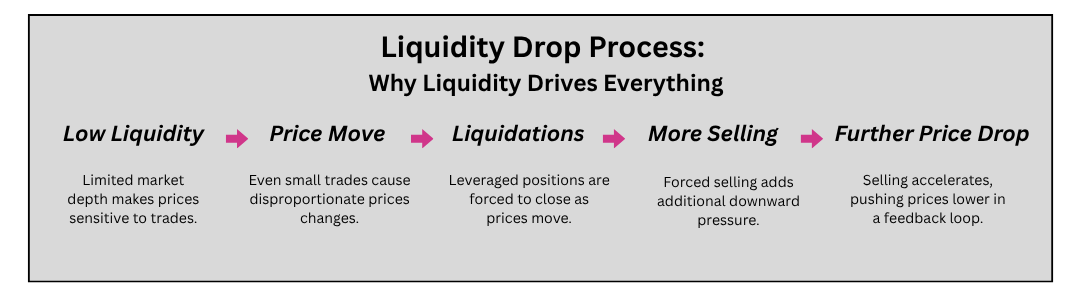
Crypto markets have experienced several liquidity shocks, often triggered by structural weaknesses rather than simple price declines.
These events typically involve a breakdown in one part of the system—an exchange, a major fund, or a key asset—which then spreads through interconnected markets.
What they reveal is that liquidity is not evenly distributed or guaranteed. It is fragile, and in some cases, highly dependent on confidence.
Because liquidity is spread across many platforms, it cannot always be efficiently accessed during periods of stress.
This fragmentation means:
During calm conditions, fragmentation creates arbitrage opportunities. During crises, it amplifies instability.
For institutional participants, liquidity is often the primary consideration.
Large investors need to be able to enter and exit positions without significantly impacting the market. If liquidity is insufficient, the risk of participation increases dramatically.
This is one reason why liquidity growth is closely tied to broader adoption—markets must be able to support larger flows of capital.
The structure of crypto markets is evolving to support deeper and more resilient liquidity.
This includes improvements in infrastructure, better connectivity between trading venues, and the growth of derivatives markets that allow for more efficient risk management.
While these developments may reduce volatility over time, liquidity will likely remain a defining factor in how crypto markets behave.
Liquidity is what holds crypto markets together. It determines not just how markets function, but how they fail.
Understanding liquidity provides a clearer view of both opportunity and risk—and is essential for navigating the space effectively.