April 26, 2026
3 minutes

April 26, 2026
3 minutes

Traditional finance relies on institutions—banks, exchanges, and intermediaries—to facilitate financial activity. In crypto, many of these functions are being rebuilt as software.
These systems are known as financial protocols. They enable lending, trading, and asset management without relying on centralized control, forming the foundation of what is commonly referred to as decentralized finance, or DeFi.
Understanding how these protocols work is key to understanding how crypto is evolving beyond simple asset transfers into a full financial system.
A financial protocol is a set of rules encoded in smart contracts that enables financial activity on a blockchain.
Instead of relying on an intermediary to process transactions or manage assets, these protocols operate automatically based on predefined logic.
At a high level, they allow users to:
Because they run on-chain, these systems are typically transparent, programmable, and accessible to anyone with a compatible wallet.
Financial protocols replace traditional intermediaries with code.
When a user interacts with a protocol, they are not dealing with a company—they are interacting directly with a smart contract. The rules governing that interaction are predefined and executed automatically.
For example, a lending protocol may require users to deposit collateral before borrowing. If the value of that collateral falls below a certain threshold, the position may be liquidated automatically.
This structure removes discretion from the system, replacing it with deterministic rules.
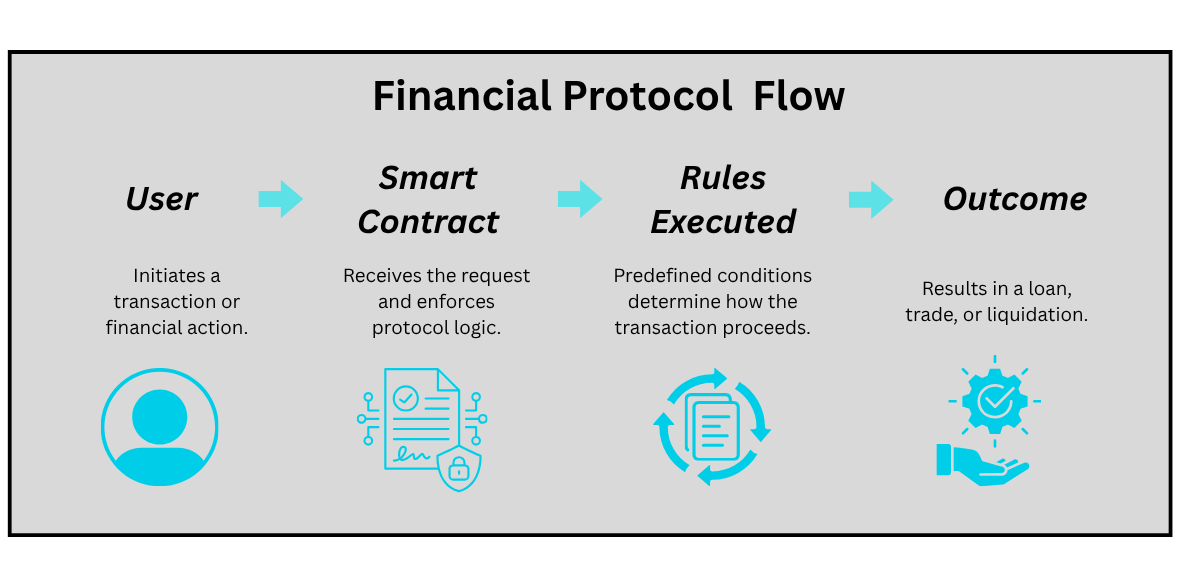
While the ecosystem is constantly evolving, most financial protocols fall into a few core categories.
Lending Protocols
These platforms allow users to supply assets and earn interest or borrow against collateral. They function as decentralized money markets.
Decentralized Exchanges (DEXs)
DEXs enable users to trade assets directly on-chain, typically using automated market makers rather than order books.
Derivatives Protocols
These systems allow users to gain exposure to price movements through instruments like perpetual futures or options.
Yield and Asset Management Protocols
These protocols aggregate strategies, helping users optimize returns across different opportunities.
Each of these categories represents a core financial function being rebuilt in a decentralized way.
One of the most important characteristics of financial protocols is composability.
Because protocols are built on shared infrastructure and open standards, they can interact with one another. This allows developers and users to combine multiple protocols into more complex systems.
For example, a user might:
This interconnected structure is often described as “money legos.”

While financial protocols offer new capabilities, they also introduce new risks.
These include:
Unlike traditional finance, there is often limited recourse if something goes wrong.
Understanding these risks is essential to understanding how these systems function in practice.
Financial protocols represent a shift from institution-based finance to system-based finance.
They enable:
At the same time, they challenge existing models by removing intermediaries and redistributing control.
Financial protocols are not just applications—they are the foundation of a new financial architecture.
Understanding how they work provides insight into how finance itself may evolve in the years ahead.