March 1, 2026
2 minutes
August 30, 2026
10-12 minutes
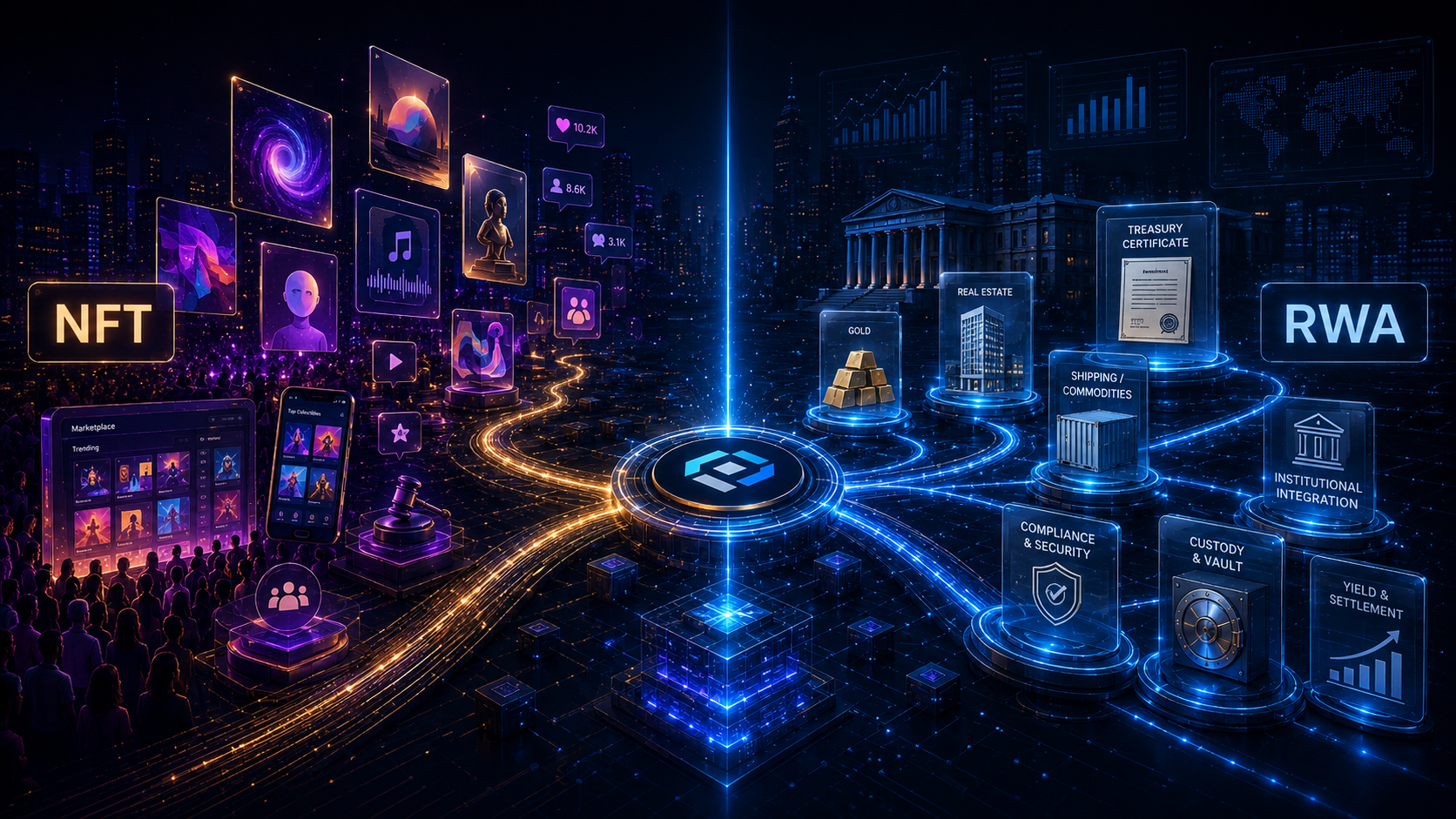
Real-world assets have become one of the fastest-growing areas of blockchain finance.
Tokenized Treasuries, funds, private credit, commodities, equities, and other financial instruments are moving on-chain at an accelerating pace. Distributed RWA value reached approximately $38 billion by August 2026, excluding stablecoins, while tokenized Treasury products alone represented roughly $15.6 billion.
The comparison with the last major tokenization boom is unavoidable.
In 2021, NFTs appeared to demonstrate blockchain's ability to create an entirely new asset market almost overnight. Digital artwork and collectible projects generated extraordinary trading activity, drew millions of new users into crypto, and created marketplaces that briefly looked capable of becoming major financial platforms. Then activity collapsed. RWAs are following a very different trajectory.
Importantly, saying that RWAs are “scaling faster” requires some qualification. NFTs expanded extraordinarily quickly by measures such as speculative trading volume. DappRadar recorded more than $23 billion in NFT trading volume during 2021, while Chainalysis found at least $44.2 billion worth of cryptocurrency sent to Ethereum contracts associated with NFT marketplaces and collections that year.
RWAs have not necessarily exceeded that speed in speculative turnover. What they are doing faster is moving from blockchain experiment to integrated financial infrastructure. That distinction tells us something important about which forms of tokenization are likely to matter most.
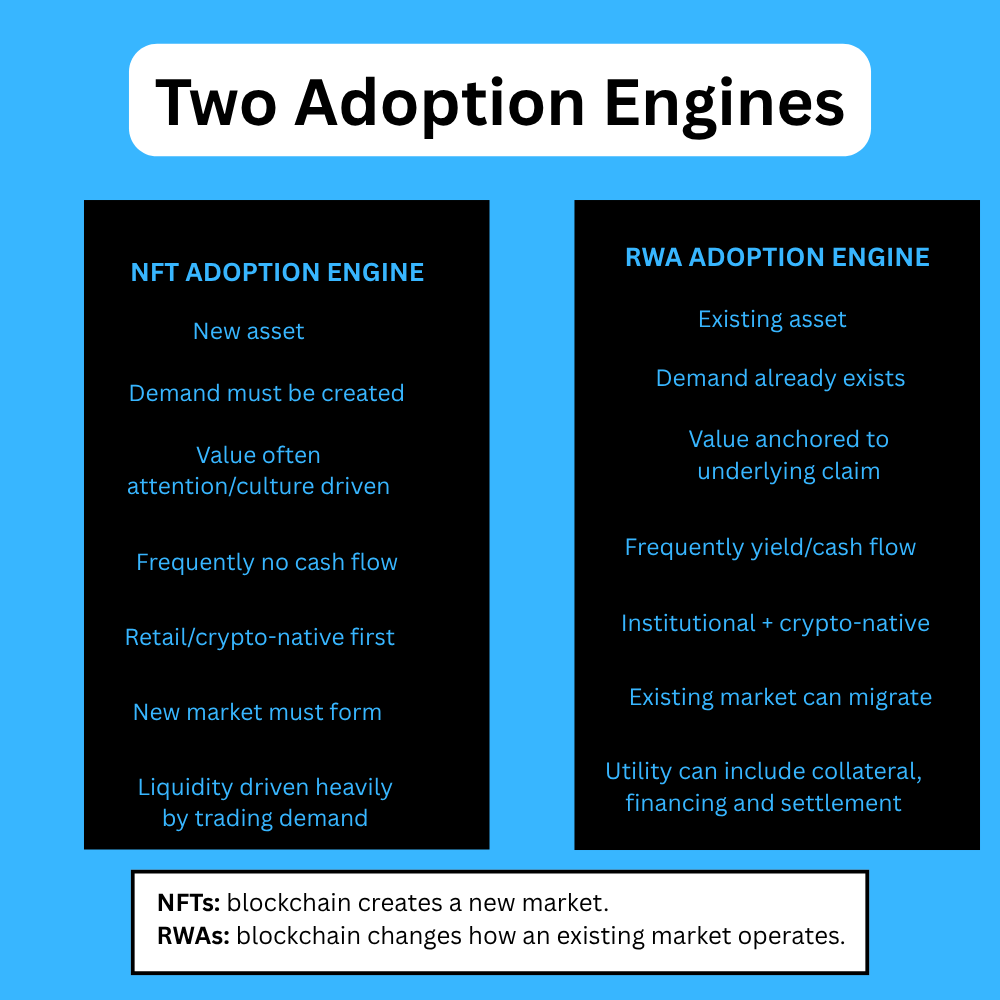
The NFT boom began with a difficult economic proposition. Blockchain technology made digital scarcity possible. But scarcity does not automatically create value.
An NFT collection needed to generate its own reason for existing. That might come from artistic value, community membership, gaming utility, cultural relevance, celebrity participation, status, or the expectation that another buyer would eventually pay more.
Successful projects created extremely powerful demand loops. But the asset and the demand for the asset were usually created at approximately the same time. That made many NFT markets highly reflexive.
Prices increased because attention increased. Attention increased because prices increased. Rising prices attracted traders, which increased transaction volume, which created additional attention.
Once that cycle reversed, there was often little external source of demand capable of stabilizing the market. RWAs begin from almost the opposite position.
A Treasury bill already has value before it is tokenized. So does a share of stock. So does a loan. So does a money-market fund. So does gold.
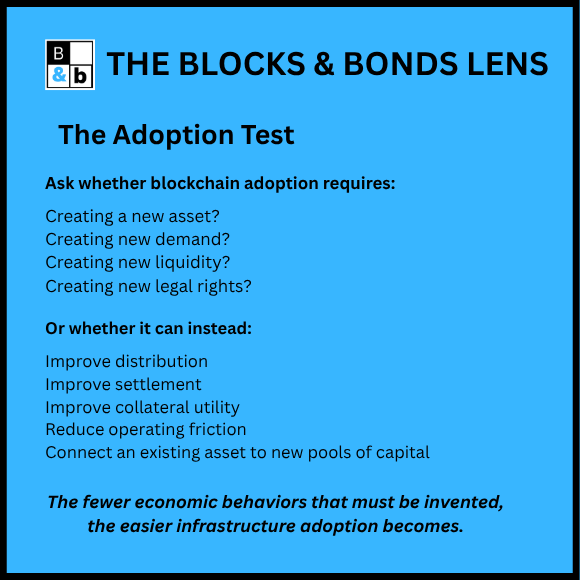
Tokenization does not need to convince the market that these assets should exist. It changes how existing assets are issued, distributed, owned, transferred, settled, financed, or used as collateral.
That dramatically lowers one of the largest adoption barriers faced by earlier blockchain assets. The investor does not have to believe in a new form of value. The investor only has to believe that the new infrastructure provides a better way to access value that already exists.
This may sound like splitting hairs, but that is not the case. It is one of the most important differences between the NFT cycle and the RWA cycle.
Many RWAs also produce something most collectible NFTs did not:
These cash flows give investors a framework for valuation that exists independently of blockchain-market sentiment. That matters because financial assets do not need endless new buyers to justify their existence.
If an investor can earn an economically attractive return from holding the asset, ownership itself has utility. The growth of tokenized Treasuries illustrates the point.
When U.S. interest rates increased while crypto-native lending yields declined, on-chain investors suddenly had a reason to move stablecoin balances into tokenized government securities. RWA.xyz describes this as a key moment when tokenized Treasuries found clear product-market fit as on-chain capital sought access to traditional yield.
Blockchain did not create Treasury demand.It opened a new distribution channel for it.
RWAs also benefit from infrastructure that NFTs helped develop but never possessed at comparable maturity. Hundreds of billions of dollars now exist in stablecoins. That represents a large pool of dollar-denominated capital already operating on blockchain networks.
For the first time, traditional financial products can be distributed directly into an environment where the money needed to purchase them already exists. This changes the economics of tokenization.
An asset manager does not necessarily have to persuade an investor to move money into crypto simply to buy a tokenized fund. The investor may already hold USDC, USDT, or another stablecoin and may actively be looking for somewhere productive to deploy that capital.
Tokenized Treasuries created an obvious answer. Private credit, equities, funds, and other products are following. Stablecoins therefore function not merely as another tokenized asset category but as part of the distribution infrastructure supporting the RWA market.
This relationship helps explain why RWAs are emerging now rather than during the first blockchain-tokenization experiments a decade ago. The financial rails surrounding them have become substantially more mature.
NFT adoption was predominantly bottom-up. Consumers and crypto-native users adopted the assets first. Large institutions arrived later, often because they wanted exposure to the audience or cultural phenomenon surrounding them.
RWA tokenization is increasingly developing from both directions. Crypto-native capital wants access to traditional financial products. At the same time, asset managers, banks, custodians, exchanges, market-infrastructure providers, and financial institutions are exploring tokenization because it can address existing operational problems.
Those problems include fragmented records, slow settlement, restricted distribution, collateral mobility, reconciliation costs, limited market hours, cumbersome transfer processes, and disconnected pools of liquidity.
This creates a fundamentally different adoption dynamic. Institutions do not have to believe that blockchain will create an entirely new economy.
They can ask a narrower question: Can this infrastructure make an existing financial activity better?
That is a much easier investment case to evaluate.
The organizations participating in tokenization also look increasingly different from those driving the NFT boom.
DTCC is preparing a tokenization service designed to connect blockchain-based assets with the existing U.S. securities infrastructure. Its working group includes major banks, asset managers, custodians, brokers, market makers, crypto firms, and technology providers. In July 2026, DTCC processed live production transactions involving DTC-tokenized assets.
This is significant. The RWA market is not being built solely by startups attempting to displace financial institutions. Increasingly, financial institutions themselves are building the infrastructure.
That makes tokenization less dependent on a wholesale migration from traditional finance to a separate blockchain economy. Instead, blockchain capabilities can be inserted into existing market structures. The path to adoption becomes evolutionary rather than revolutionary. That tends to look slower than a speculative boom. It may ultimately produce much larger structural change.
NFTs initially benefited from operating in a comparatively uncertain regulatory environment. Projects could launch quickly. Marketplaces could list enormous numbers of assets. Investors could transfer them globally with little conventional financial infrastructure.
That flexibility helped the market grow. It also contributed to its fragility. RWAs face much stronger constraints.
A tokenized security remains a security. The SEC reiterated that principle in its 2026 guidance, emphasizing that putting an instrument on a blockchain does not change the legal nature of the underlying claim.
At first glance, that makes RWA adoption harder. In another sense, it gives the market a foundation NFTs often lacked.
The rules create friction. They also create trust. For institutional capital, the second feature may be more important than the first.
The NFT market ultimately competed for spending allocated to collectibles, gaming items, art, status goods, and speculative assets. Those can be substantial markets. RWAs potentially address:
The underlying asset pools are measured in trillions of dollars. Tokenization does not have to capture all—or even most—of those markets to become economically significant.
A relatively small migration of existing financial assets onto programmable infrastructure can create an on-chain market far larger than previous crypto-native asset categories. That asymmetry changes the growth equation.
NFT projects generally needed to create new economic value. RWA platforms can redirect a fraction of existing economic value through new infrastructure.
The RWA market remains small relative to traditional finance, but its trajectory is increasingly meaningful.
Dune reported in August 2026 that tokenized RWAs excluding stablecoins grew from approximately $13.6 billion to $31.5 billion over the previous year across four major asset classes. Tokenized equities alone increased from roughly $61 million to $2.47 billion.
Other datasets show distributed RWA value moving above $38 billion during August, with approximately 1.8 million holders. This growth has been occurring across multiple financial categories rather than one dominant collectible narrative. That breadth is important.
The NFT boom demonstrated that blockchain could create enormous transactional activity quickly. The RWA market is beginning to demonstrate something different: Blockchain can become part of the infrastructure through which conventional financial assets are distributed and used.
There is an important warning inside the RWA numbers. Asset value is growing faster than secondary-market liquidity. Many tokenized assets still barely trade. Ownership can be highly concentrated.
A July 2026 analysis of RWA market activity found that a large portion of tokenized value recorded little or no weekly transfer activity. That means the industry should resist celebrating every dollar placed on-chain as evidence of a functioning market.
Some tokenization is primarily a recordkeeping improvement. Some products have broad distribution. Others remain concentrated among a handful of holders. Some have meaningful secondary trading. Others effectively have none.
This does not undermine the RWA thesis. It tells us where the next infrastructure problem lies. The first challenge was getting assets on-chain. The next challenge is building markets around them.
NFTs were not a failed experiment. They demonstrated several important blockchain capabilities at enormous scale.
Those capabilities helped normalize concepts that now appear inside financial tokenization. RWAs are applying similar infrastructure to a different economic problem.
Instead of asking whether blockchain can create new digital property, the question is whether blockchain can improve the infrastructure surrounding existing financial property.
That is a much larger opportunity. And it is why the RWA cycle feels different. NFTs showed how rapidly speculation and culture could create an on-chain market. RWAs are showing how on-chain infrastructure can connect with markets that already exist.
The second process may generate fewer celebrity headlines. But if tokenization continues moving into settlement, collateral, asset management, securities distribution, and institutional market infrastructure, it will matter far more to the future of finance.
The most important blockchain adoption story may not be the creation of entirely new assets. It may be the gradual rewiring of the markets that already contain the world's capital.