
March 1, 2026
3 minutes

August 30, 2026
10-11 minutes

Stablecoins are often described as a payments innovation. That description is increasingly incomplete.
Their more consequential role may be deeper inside the financial system: as a settlement asset connecting markets, trading venues, blockchains, tokenized securities, exchanges, and eventually parts of traditional finance.
That distinction matters. Payments are about moving money from one party to another. Settlement is about completing a financial transaction—transferring an asset, transferring the money used to pay for it, and ensuring that neither side is left exposed once the transaction is complete.
As financial assets move onto programmable networks, the question of what money settles those transactions becomes increasingly important.
Stablecoins have emerged as one possible answer.
They are not the only answer. Tokenized bank deposits and tokenized central-bank money may ultimately occupy important parts of the same architecture. But stablecoins already possess something those alternatives largely do not: substantial supply, established blockchain distribution, interoperability with digital-asset markets, and a growing base of institutions willing to use them.
The result is that stablecoins are beginning to influence not only how payments are made, but how digital financial markets themselves are structured.
Imagine a tokenized Treasury security trading on a blockchain.
Putting the security on-chain solves only one side of the transaction. When an investor purchases it, something still has to move in the opposite direction. Cash.
If the security can move instantly but the cash leg still depends on a banking system operating through separate infrastructure, much of the potential advantage of tokenization disappears. This is one reason the future of tokenized assets cannot be separated from the future of tokenized money.
Traditional securities markets rely on layers of exchanges, clearinghouses, custodians, banks, central securities depositories, and central-bank settlement systems. Those institutions exist partly because buyers and sellers cannot simply exchange assets and cash simultaneously across a single shared system.
Programmable ledgers potentially alter that architecture.
A tokenized asset and a tokenized form of money can theoretically be transferred as parts of the same transaction. Smart contracts can make the transfers conditional: the asset moves only if the payment moves.
That creates the possibility of near-instantaneous delivery-versus-payment settlement. Stablecoins are currently the most widely available form of tokenized money capable of performing that function on public blockchains.
Stablecoins initially developed primarily as infrastructure for crypto markets.
Traders needed an asset that could remain inside the digital-asset ecosystem without taking Bitcoin or Ether price risk. Stablecoins became the cash equivalent used between trades, across exchanges, inside DeFi protocols, and as collateral.
That function has expanded dramatically.
By August 2026, aggregate stablecoin supply was roughly $300 billion, depending on the universe and methodology used to count it. Stablecoins have become the dominant medium of exchange within crypto markets and an increasingly important pool of short-duration dollar liquidity.
But the important development is not simply that more stablecoins exist. It is where they are being used.
Visa, for example, has moved from experimentation to using USDC as a settlement option for participating financial institutions. Its stablecoin settlement pilot reached a roughly $7 billion annualized run rate in April 2026 and expanded across nine blockchains. The consumer transaction may still begin with a Visa card, but a portion of the back-end settlement infrastructure can now occur through a blockchain-based dollar instrument.
This illustrates the broader opportunity. Stablecoins can become middleware between different parts of the financial system.
Financial markets increasingly operate on infrastructure built during different technological eras. Trading may appear instantaneous to the end user. Settlement often is not.
Banking hours, cutoff times, weekends, correspondent relationships, reconciliation processes, and jurisdictional differences still shape how money moves behind the scenes.
Stablecoins operate differently.
A blockchain does not need to close Friday evening and reopen Monday morning. A dollar-denominated token can move between eligible participants whenever the underlying network is operating. That capability changes treasury management.
An institution that needs liquidity on Saturday no longer necessarily has to prefund every potential obligation on Friday. A trading venue operating globally can potentially move settlement assets between counterparties continuously. Cross-border transfers can move without waiting for several sequential banking systems to reconcile their records.
This does not eliminate liquidity needs. It changes when and where liquidity can be deployed.
Visa specifically identifies seven-day settlement windows and more flexible treasury management as advantages of its stablecoin settlement architecture. For financial institutions, that may ultimately prove more important than the consumer ability to “pay with crypto.”
The significance becomes clearer as tokenized securities expand.
Tokenized Treasury products, private credit, funds, equities, commodities, and other real-world assets now represent tens of billions of dollars of distributed on-chain value. Tokenized U.S. Treasuries alone were approximately $15.6 billion by August 2026. These assets need a settlement currency.
Stablecoins offer an obvious candidate because both sides of the transaction can exist within compatible programmable environments. The result could be something traditional markets have historically found difficult to achieve: continuous markets in which assets, cash, collateral, and settlement instructions exist within the same digital environment.
The implications extend beyond simply buying and selling securities.
An investor might hold a tokenized Treasury fund, pledge it as collateral, borrow stablecoins against it, purchase another asset, receive distributions, and rebalance collateral—all without repeatedly moving between blockchain networks and legacy banking infrastructure.
The asset becomes programmable. But so does the money surrounding it. This is where stablecoins begin to affect market structure.
It would be tempting to conclude that this architecture eliminates financial intermediaries. More likely, it changes what intermediaries do.
Markets still require custody, compliance, identity verification, risk management, pricing, liquidity provision, market making, dispute resolution, asset servicing, and regulatory oversight.
Those functions do not disappear because settlement occurs on a blockchain. What may disappear—or at least shrink—is some of the reconciliation work created by maintaining multiple disconnected records of the same transaction.
If participants can operate from synchronized infrastructure, the economic role of certain intermediaries shifts from maintaining separate ledgers toward providing access, trust, compliance, liquidity, and risk management.
That shift is central to understanding financial tokenization. Blockchain does not necessarily remove institutions. It can change which institutional functions remain economically valuable.
There is also a larger monetary competition developing beneath this architecture. Stablecoins are one possible settlement asset. Tokenized commercial-bank deposits are another. Tokenized central-bank money could become a third, particularly in wholesale markets.
The Bank for International Settlements has repeatedly argued that tokenized central-bank reserves and commercial-bank deposits may provide a stronger monetary foundation for large-scale tokenized markets than privately issued stablecoins alone. Its concern centers on the “singleness of money”: a dollar should remain a dollar regardless of which institution or technological system represents it.
Stablecoins introduce additional layers of issuer, reserve, redemption, and liquidity risk.
A USDC token and a dollar deposit may trade at essentially the same value under normal conditions, but they remain legally and structurally different claims. At sufficient scale, that matters.
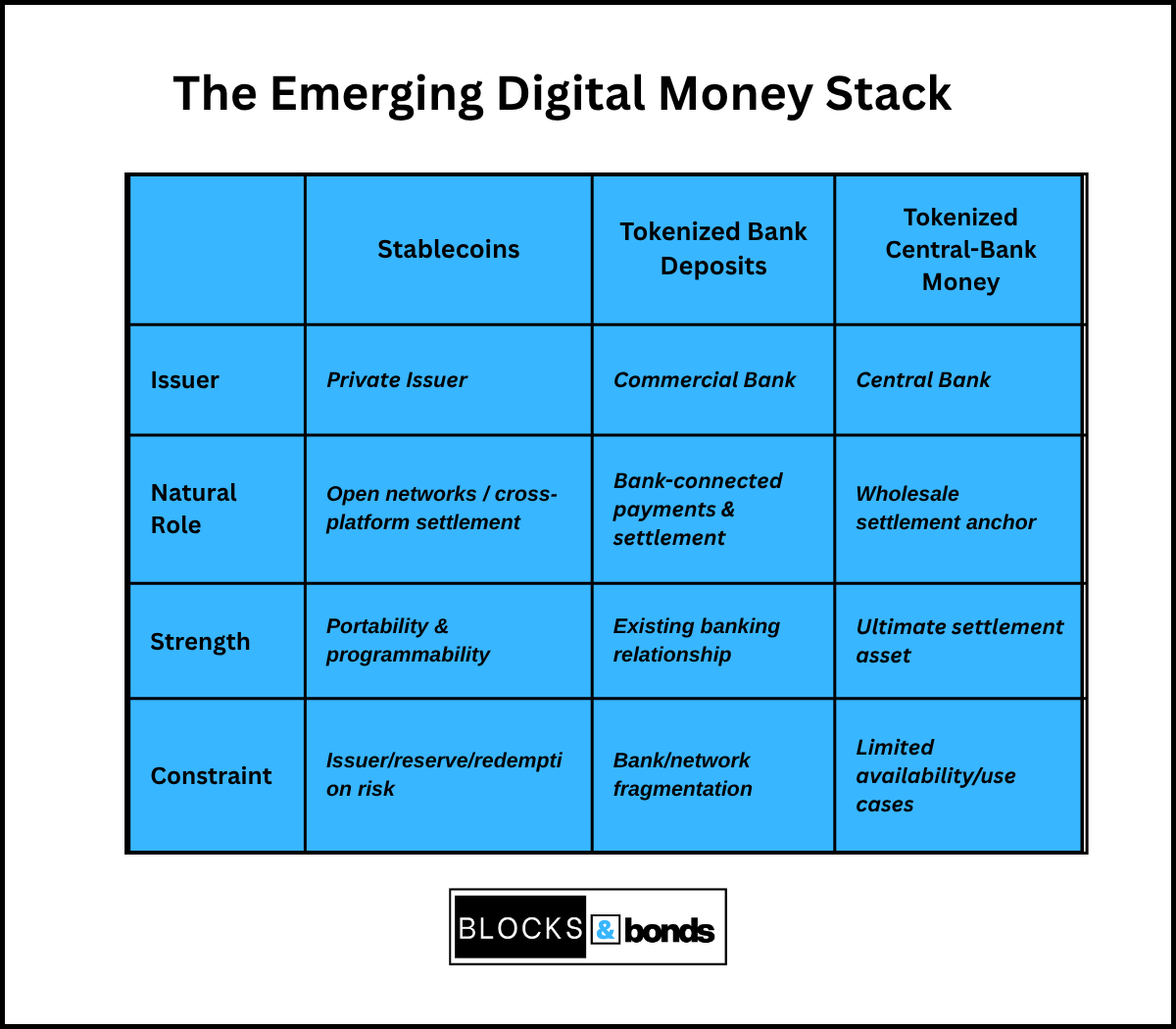
This is why the long-term architecture is unlikely to consist of stablecoins simply replacing bank money. Instead, several forms of digital money may coexist.
Stablecoins may dominate open blockchain environments and cross-platform settlement. Tokenized deposits may connect blockchain functionality with the commercial banking system. Central-bank money may remain the ultimate settlement anchor for systemically important wholesale markets.
The important question becomes interoperability among them.
The United States took an important step toward defining that role when the GENIUS Act became law in July 2025. The law created a federal framework for payment stablecoins, including reserve and redemption requirements. Implementation has continued through 2026, with the OCC proposing rules covering reserves, custody, risk management, reporting, supervision, and other issuer obligations.
This matters for market structure because institutions cannot treat an asset as reliable settlement infrastructure solely because it works technically.
They must understand who issued it, what backs it, how redemption works, what happens during stress, who supervises the issuer, and what legal claim the tokenholder possesses. Regulation therefore does more than protect consumers. It helps determine whether stablecoins can function as financial infrastructure.
Moving settlement onto programmable networks does not make settlement risk disappear. It changes its form.
Liquidity can become fragmented across stablecoins and blockchains. Different institutions may accept different settlement assets. Bridges and interoperability layers introduce additional technical dependencies. Stablecoin issuers create concentrated points of operational and reserve risk. Smart contracts create another potential failure surface.
The Federal Reserve has also highlighted the growing interconnections between stablecoin issuers, reserve assets, service providers, wallets, and the traditional financial system. As those connections deepen, stress in one part of the system can potentially transmit into another.
A market with twenty tokenized dollars and thirty incompatible networks is not necessarily more efficient than the market it replaces. The value of tokenization therefore depends partly on whether the industry solves interoperability rather than simply producing additional infrastructure.
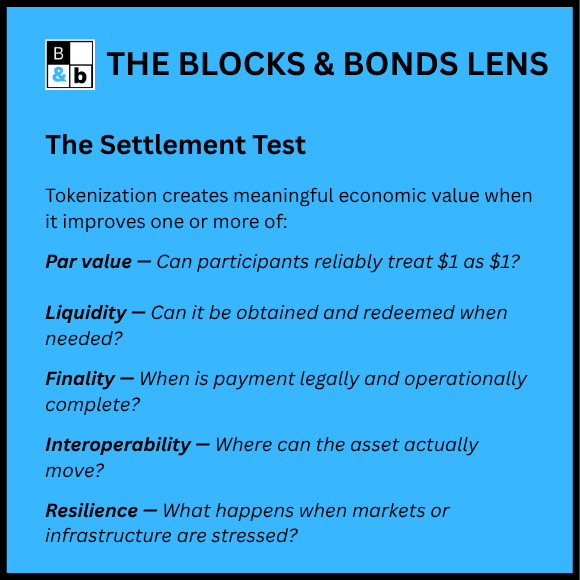
Stablecoins began as a workaround for crypto traders. They are becoming something much more interesting: an early example of programmable settlement money.
That does not mean they will become the universal foundation of the financial system.
They may instead become one component in a broader architecture combining stablecoins, tokenized deposits, central-bank money, tokenized securities, traditional custodians, decentralized protocols, and regulated financial-market infrastructure. But even that outcome would represent a meaningful change.
For decades, the digitization of finance concentrated primarily on the front end. Trading screens improved. Banking applications improved. Payments became easier for consumers.
The underlying movement of assets and money remained considerably more fragmented. Tokenization is beginning to push digitization deeper into the financial stack. And stablecoins matter because every tokenized market ultimately encounters the same basic question:
What settles the trade? Increasingly, stablecoins are becoming one of the answers.