
March 1, 2026
3 minutes

Scott Kasten
March 1, 2026
4 minutes

Stablecoins are frequently described as digital representations of fiat currency. That description captures their form but obscures their function. In practice, stablecoins are best understood as settlement technology — mechanisms that alter how value moves, clears, and reconciles across financial systems.
Much of the debate surrounding stablecoins focuses on issuance models, reserve composition, or regulatory classification. Yet their most consequential impact lies elsewhere: in the distinction between on-chain and off-chain settlement.
Understanding this divide clarifies where stablecoins generate genuine economic efficiency — and where claims of transformation are overstated.
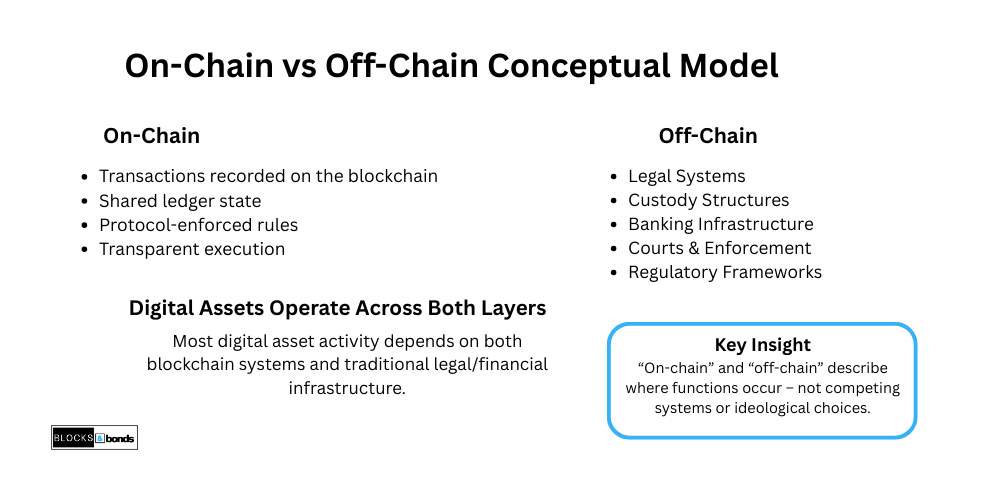
Settlement is the process through which financial obligations are discharged. Trades may execute instantly, but settlement determines when counterparties are made whole, collateral is released, and risk is extinguished.
In traditional systems, settlement often involves:
These structures evolved to balance risk, liquidity, and operational constraints. They are robust but friction-heavy.
Stablecoins introduce an alternative: atomic, near-instant settlement on shared ledgers.
On-chain settlement compresses several layers of financial friction:
1. Counterparty Risk Compression
Faster finality reduces exposure windows.
2. Liquidity Efficiency
Capital is not trapped in pending cycles.
3. Reconciliation Reduction
Shared state lowers matching overhead.
4. Temporal Neutrality
24/7 operation removes cut-off dependencies.
These efficiencies matter most in high-velocity environments: trading, cross-border transfers, collateral movements, and treasury operations.
Despite the efficiency gains, off-chain systems persist because they perform critical functions:
Most stablecoin transactions ultimately intersect with off-chain realities:
Stablecoins therefore do not eliminate traditional settlement layers. They interoperate with them.
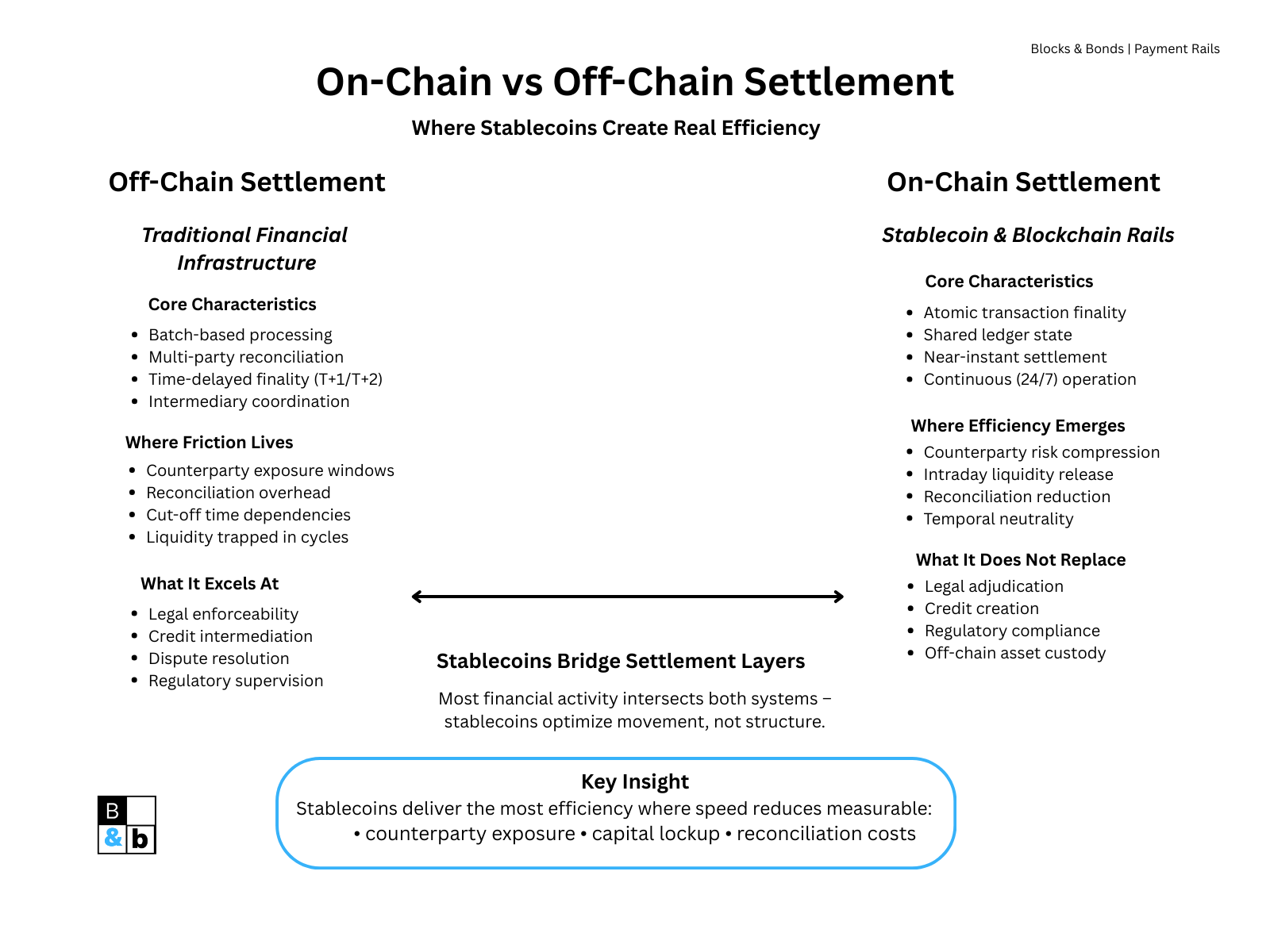
Stablecoins succeed not by replacing financial infrastructure, but by optimizing specific settlement pathways.
Real efficiency appears where:
Transformation is weakest where:
Stablecoins are often framed as monetary innovation. Their deeper contribution is architectural:
Stablecoins turn settlement from an institutional process into a software process.
This shift resembles earlier transitions in electronic trading and clearing — operational revolutions that restructured markets without fundamentally altering asset classes.
The distinction between on-chain and off-chain settlement is not a technological curiosity. It is the key to understanding where stablecoins generate durable value.
Stablecoins are most powerful not as currencies, but as risk-compressing settlement infrastructure embedded within existing financial systems.