
March 1, 2026
3 minutes

Scott Kasten
March 1, 2026
5 minutes

(Blocks & Bonds | Research Brief)
Stablecoins are often discussed as instruments of technological efficiency or monetary innovation. Yet in institutional contexts, their viability depends less on technical architecture than on compliance architecture.
Contrary to common crypto narratives, compliance is not an external constraint imposed on stablecoin systems. It is a core functional layer that enables scale, liquidity, and institutional participation.
Understanding this inversion — compliance as a feature rather than friction — is essential to understanding how stablecoins actually integrate into regulated financial markets.
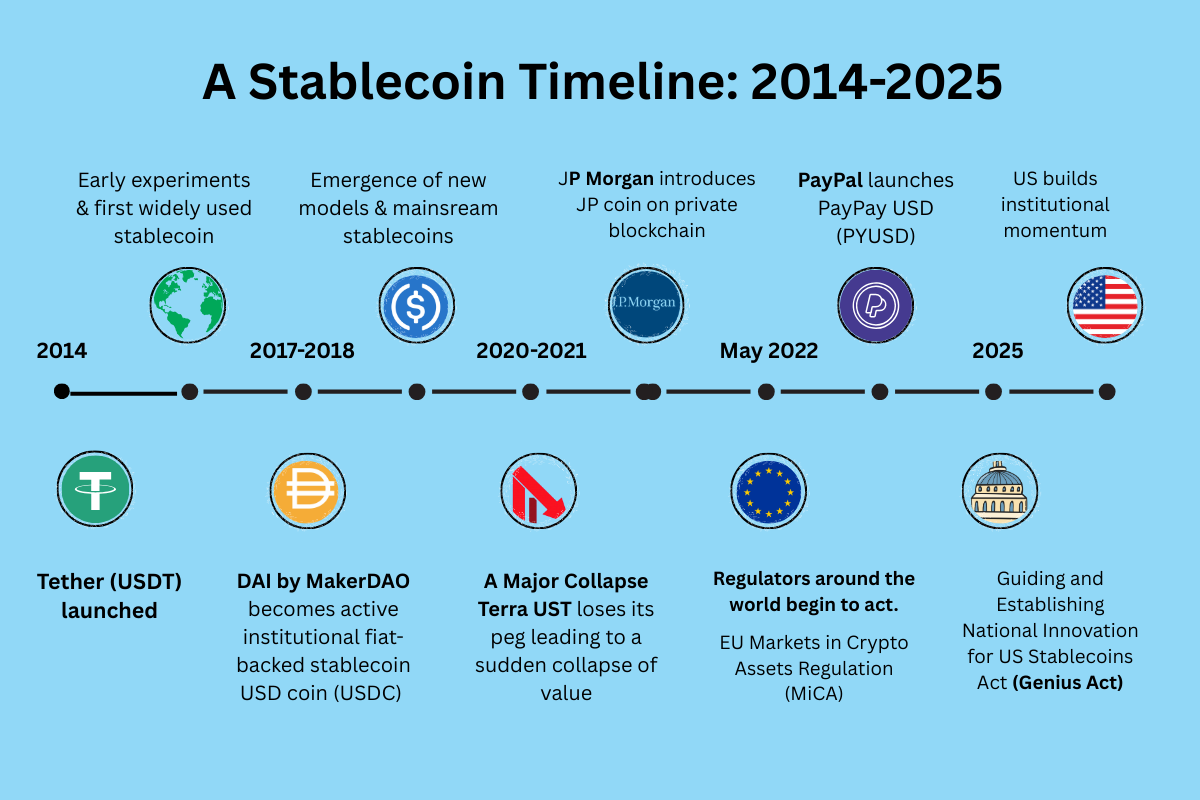
Early crypto discourse framed compliance as antithetical to decentralization:
This framing made sense in experimental, retail-driven markets. It breaks down in environments where:
Stablecoins operate increasingly within the latter.
In traditional finance, compliance functions as market infrastructure:
Stablecoins replicate this pattern.
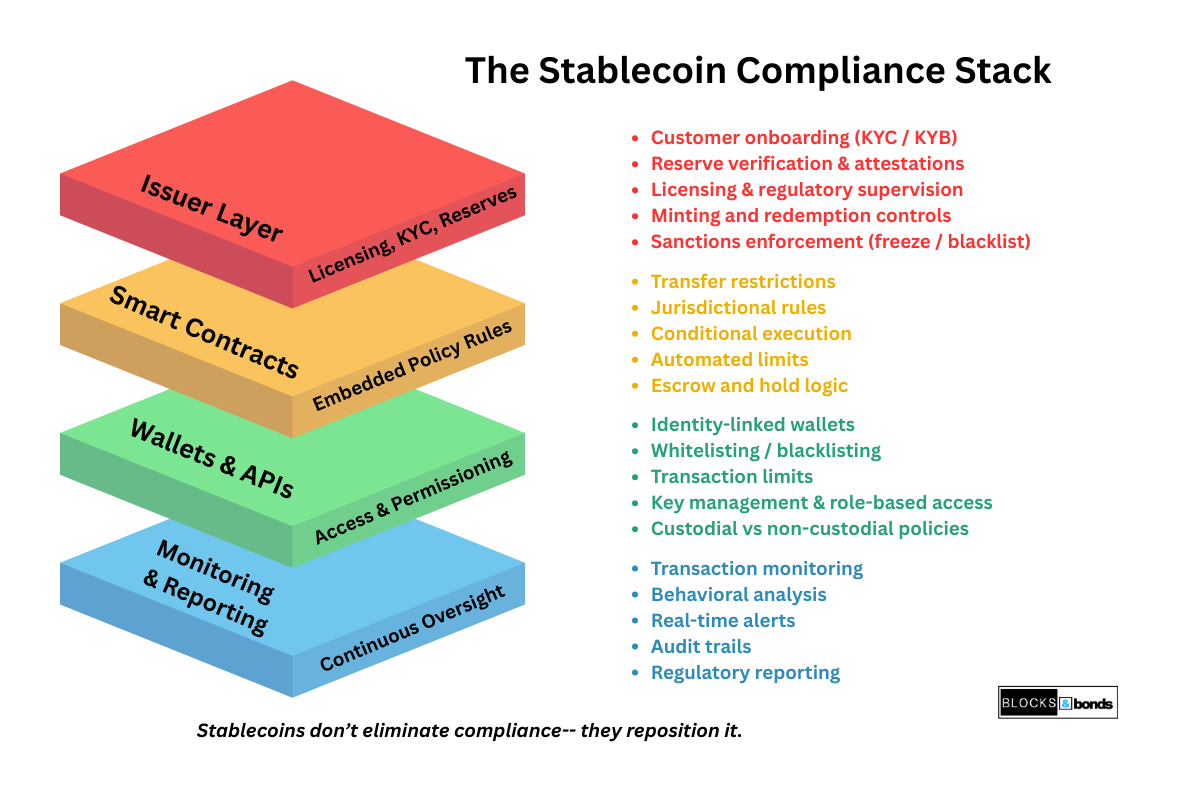
Compliance layers are not bolted onto stablecoins. They are embedded within:
✅ Issuer design
✅ Reserve management
✅ Custody arrangements
✅ Redemption mechanisms
✅ Distribution channels
A stablecoin without compliance architecture is not merely risky — it is economically non-viable at scale.
Institutional actors face constraints fundamentally different from retail participants:
Stablecoins succeed where they reduce settlement friction without increasing regulatory friction.
Compliance provides:
In effect:
Compliance transforms stablecoins from speculative instruments into usable financial infrastructure.
Compliance is not purely defensive. It produces economic value.
1. Liquidity Expansion
Regulated entities can participate.
2. Risk Compression
Clear monitoring and controls reduce uncertainty.
3. Network Legitimacy
Institutions adopt systems deemed supervisable.
4. Revenue Stability
Compliance-compatible rails attract durable flows.
This mirrors historical payment networks, clearinghouses, and custodial systems.
Markets scale where risk is governable.
As stablecoin markets mature, differentiation shifts away from:
❌ Token mechanics
❌ Yield narratives
❌ Ideological positioning
Toward:
✅ Regulatory compatibility
✅ Monitoring & reporting capabilities
✅ Control & freeze mechanisms
✅ Jurisdictional operability
Stablecoin winners will resemble financial utilities, not crypto experiments.
Stablecoins illustrate a broader industry transition:
Early Crypto → Regulation Avoidance
Maturing Crypto → Regulation Integration
Compliance is not eroding stablecoins’ relevance.
It is defining their investability.
In stablecoin markets, compliance is not friction layered onto innovation.
It is the mechanism that converts innovation into infrastructure.
The most durable stablecoin systems will not be those that minimize regulation, but those that operationalize it efficiently.
Key Insight
In institutional finance, compliance is not the cost of scale. It is the prerequisite for scale.