
April 26, 2026
9 minutes

October 11, 2026
10 minutes
.png)
For much of the digital-asset industry's history, institutional adoption was measured by a relatively simple question: Are traditional financial firms willing to own crypto?
That question is becoming less useful.
Banks, asset managers, payment companies and other financial institutions are increasingly interacting with blockchain infrastructure without necessarily building a business around holding Bitcoin or other cryptoassets. Stablecoins can function as payment and settlement instruments. Treasury funds can be issued as tokens. Collateral can move across programmable networks. Deposits can be represented on shared ledgers. Securities can potentially settle against digital cash.
The International Monetary Fund has described tokenization as something more consequential than another round of financial digitization. Earlier technological changes largely made existing financial processes faster. Tokenization potentially reorganizes how ownership, settlement and trust themselves are structured.
That changes the institutional question.
It is no longer simply: Should we participate in digital assets?
It is increasingly: What infrastructure must exist for us to participate safely, legally and economically?
The answer is not one blockchain, one custodian or one tokenization platform. Institutional participation requires a stack.
Understanding that stack also helps explain why institutional adoption has often moved more slowly than technological capability. A blockchain transaction may settle in seconds. Building the institutional architecture around that transaction is considerably more complicated.
The first generation of institutional digital-asset infrastructure was largely constructed around exposure.
An institution that wanted access to Bitcoin or Ether needed an exchange or trading venue, institutional custody, liquidity, compliance controls and accounting systems capable of handling the assets.
That infrastructure remains important, but the market is expanding in another direction.
Consider a tokenized money-market fund.
The institution participating in that market may need to interact with:
The token itself is only one component.
This is why the emerging institutional digital-asset market is best understood as a financial infrastructure stack. At Blocks & Bonds, we divide that stack into seven interconnected layers.
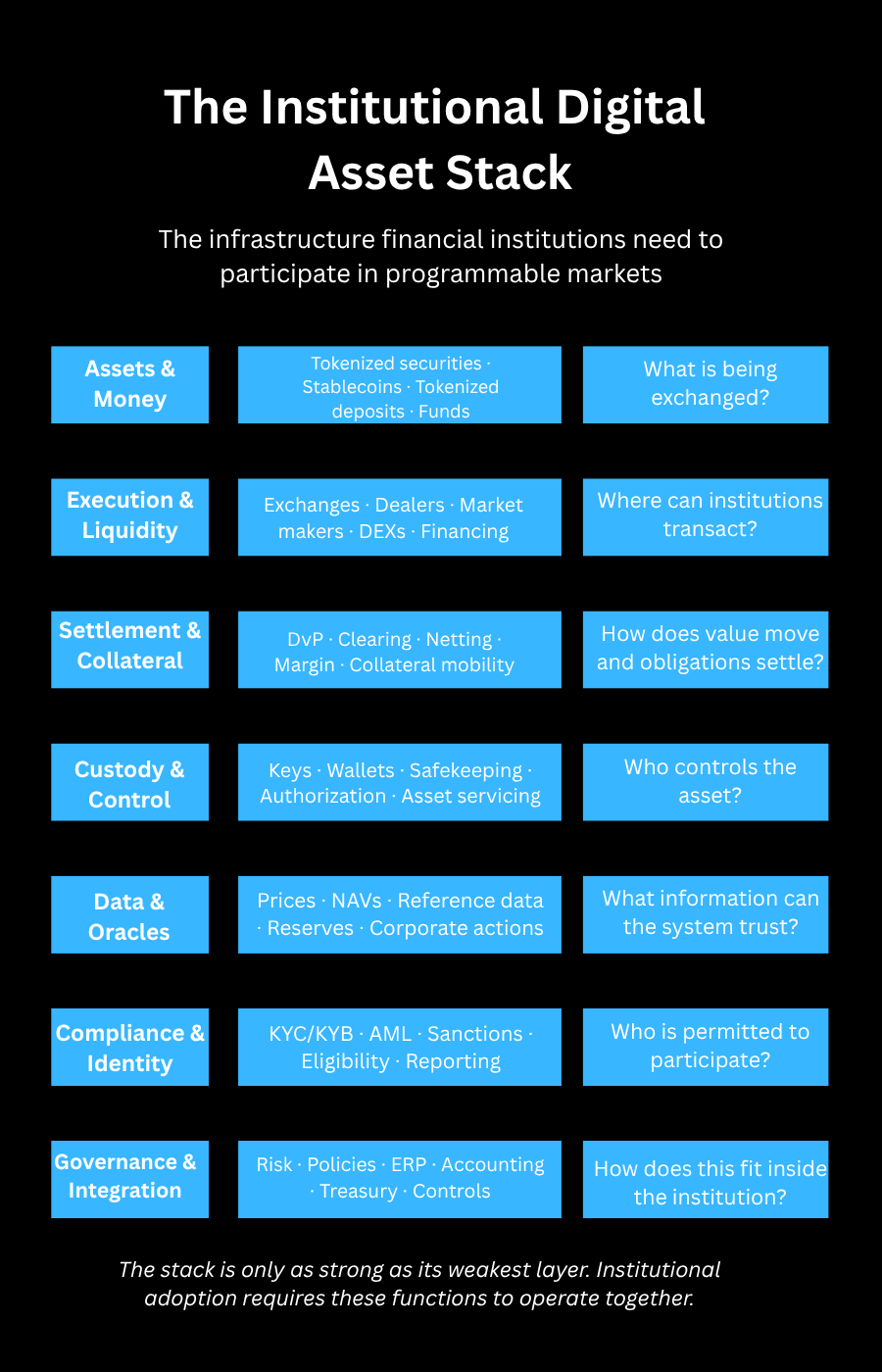
Every financial system begins with the instruments being exchanged.
In digital markets, this layer increasingly contains two distinct categories.
The first is tokenized financial assets:
The second is digital money:
The distinction matters because tokenizing an asset without providing an efficient way to pay for it solves only half the transaction.
A tokenized Treasury fund that must ultimately settle through conventional banking rails may gain some operational benefits from tokenization, but the transaction remains split across different systems.
A more consequential architecture emerges when the asset and the money used to purchase it can operate within interoperable digital environments.
That is what makes delivery-versus-payment potentially programmable and, in some cases, atomic: ownership of the asset and payment can be coordinated rather than occurring through multiple disconnected intermediaries.
The IMF has highlighted precisely this combination of programmable assets, shared ledgers and synchronized settlement as one of tokenization's most significant departures from traditional financial infrastructure.
The institutional contest is therefore not simply about which assets become tokenized.
It is also about what becomes money inside tokenized markets.
Stablecoins, tokenized deposits and potentially tokenized central-bank liabilities represent different answers—and different allocations of credit, liquidity and regulatory risk.
Digital assets introduce a deceptively simple question:
Who controls the asset?
In conventional finance, custody is supported by layers of legal relationships, regulated intermediaries, books and records, reconciliation systems and established procedures for recovering or transferring assets.
Blockchain systems add cryptographic control.
Control of a private key can determine whether an asset can move.
Institutional custody therefore has to solve several problems simultaneously:
This makes custody much more than secure storage.
It becomes part of the institution's operating control environment.
The development of custody infrastructure is consequently moving toward broader platforms. Citi, for example, launched its Custody+ suite in August 2026 around a move toward increasingly continuous markets, compressed settlement cycles and real-time servicing.
That evolution illustrates a larger trend.
As tokenized markets develop, the successful custodian may not simply be the company holding keys. It may become an operating bridge connecting conventional securities infrastructure, tokenized assets, settlement systems and institutional workflows.
Owning a token does not create a market.
Institutional markets require the ability to:
This is where many tokenization narratives encounter their first major constraint.
Issuing a tokenized asset can be technically straightforward. Creating a deep and resilient secondary market is not.
Liquidity may be fragmented between exchanges, dealers, decentralized venues, private networks and different blockchain ecosystems. Identical or economically similar assets may exist in technically incompatible environments.
Institutional investors consequently need infrastructure connecting tokenized instruments to the familiar functions performed by:
The institutional digital-asset market will therefore not be determined simply by which blockchain processes the greatest number of transactions.
A more important question may be: Where can institutions reliably find liquidity?
Infrastructure tends to consolidate around liquidity. Digital finance is unlikely to be an exception.
Settlement is where blockchain infrastructure begins to challenge some of the deepest assumptions of financial-market design.
Traditional securities markets deliberately separate trading from settlement. That delay permits processes including clearing, netting, financing, collateral management and operational reconciliation.
Tokenized systems can compress some of those processes.
If an asset and a settlement instrument exist on compatible infrastructure, delivery-versus-payment can potentially occur nearly simultaneously. That can reduce settlement and counterparty exposure. But faster settlement does not eliminate financial risk. It can move it.
The IMF has emphasized this trade-off: atomic or near-real-time settlement can reduce counterparty exposures while simultaneously increasing the need for intraday liquidity because institutions lose some of the flexibility created by delayed settlement and netting.
That makes collateral a particularly important part of the institutional stack.
Institutions need mechanisms to:
Programmable infrastructure could eventually make collateral more mobile.
A Treasury security sitting in one system could potentially become available for financing or margin elsewhere without the same layers of reconciliation and manual movement required today.
But this requires legal certainty, reliable pricing, interoperability and settlement infrastructure. The promise is significant. So are the prerequisites.
Traditional finance depends on enormous quantities of data that are often invisible to the end investor.
Digital markets do not eliminate this dependence. They make the relationship between data and execution more important. A smart contract can execute automatically. But it must know what is true.
If a token represents a Treasury security, who confirms the underlying asset exists?
If a tokenized fund trades at a particular value, where does its NAV come from?
If collateral falls below a required threshold, whose price determines whether liquidation occurs?
If ownership restrictions apply, where does eligibility information originate?
This is the function often associated with blockchain oracles, but institutional financial data is broader than merely providing a cryptocurrency price to a smart contract.
The emerging data layer will have to connect off-chain legal and economic reality with on-chain execution. That makes trusted data providers, verification systems and standardized reporting essential components of institutional adoption.
The financial system may move portions of its infrastructure on-chain. The need to determine which information institutions can trust will remain.
Permissionless blockchain networks were designed in part around the idea that anyone could transact.
Financial institutions operate under almost the opposite assumption.
They generally must know:
Institutional digital finance therefore requires an identity and compliance layer capable of interacting with programmable markets.
That can include:
Over time, some of these controls may increasingly become embedded directly within financial infrastructure.
A tokenized security, for example, could potentially contain transfer rules determining which wallets are eligible to receive it. A smart contract could prevent a transaction that violates specified compliance requirements. That is a substantial conceptual change.
Compliance moves from something performed around the transaction toward something potentially built into the transaction architecture. But code cannot resolve every legal question.
Someone must still determine what rights a token represents, who has legal title, what happens in insolvency, which court has jurisdiction and who bears responsibility when the technology fails.
Recent IMF research on tokenized financial-market infrastructure reaches a similar conclusion: distributed ledgers and smart contracts can assume more recordkeeping, settlement, collateral and reporting functions, while governance, legal certainty and accountability remain fundamentally institutional.
Technology may change where trust resides. It does not eliminate the need for trust.
The final layer may be the least glamorous and one of the most important.
Financial institutions already operate large technology environments containing:
Digital assets cannot exist permanently as an isolated experiment sitting beside them.
Institutional adoption requires integration. It also requires governance.
Organizations need policies governing questions such as:
This helps explain why successful institutional adoption increasingly resembles enterprise architecture rather than simply financial-product innovation.
Citi's current digital-asset platform provides a useful illustration. Its institutional offering spans tokenization, smart-contract orchestration, custody, foreign-exchange settlement, tokenized deposits, payments and securities services across public and private blockchain environments.
The significance is not that every institution will build the same platform internally. It is that the individual components are converging.
Viewed separately, the pieces can appear incremental.
Viewed together, something more significant becomes visible. Financial firms are assembling the infrastructure necessary for assets, money, ownership, compliance and settlement to operate across programmable networks.
That does not imply that the existing financial system will simply move onto public blockchains. The emerging architecture is likely to be hybrid.
Public networks may coexist with permissioned infrastructure. Stablecoins may coexist with bank deposits. Traditional custodians may interact with cryptographic custody systems. Central securities depositories may incorporate distributed ledgers rather than disappear.
The institutional transition is therefore less likely to resemble wholesale replacement than recomposition.
Functions that were once bundled together may separate. Functions historically performed by different intermediaries may collapse into the same infrastructure. New intermediaries may emerge around identity, interoperability, data and digital custody. Existing institutions may absorb blockchain functionality into products whose customers barely recognize that distributed-ledger technology is involved.
This leads to an important conclusion.
The principal constraints on institutional digital-asset adoption are increasingly less about whether blockchains can process transactions.
The harder questions concern:
Liquidity — Can institutions transact at meaningful size?
Settlement — What form of money completes the transaction?
Custody — Who controls the assets and bears responsibility?
Data — Which information can automated systems trust?
Compliance — Can institutions satisfy regulatory obligations within the architecture?
Interoperability — Can assets, money and information move between systems?
Governance — Who is accountable when infrastructure fails?
Legal certainty — What rights does the digital asset actually represent?
Those problems are considerably less visible than token prices. They are also where much of the durable economic value in digital finance may ultimately be created.
The first era of institutional digital assets was primarily about giving traditional investors access to a new asset class.
The emerging era is broader. It is about determining whether blockchain-based systems can become part of the infrastructure through which traditional financial activity itself occurs.
That transition requires far more than institutional custody or regulatory permission.
It requires a complete operating stack.
No single company necessarily needs to provide all seven. But any functioning institutional market ultimately needs all seven to exist.
That is why the competition now developing across digital finance should not be understood simply as a competition among blockchains, stablecoins or tokenization platforms.
It is increasingly a competition to determine who controls each layer of the next financial infrastructure stack—and how those layers connect.
For financial institutions, that is where the transition from experimentation to participation begins.
Continue the Analysis
The institutional stack depends on reliable information connecting off-chain financial reality with programmable markets.
Next: Financial Data Is Moving On-Chain. Who Becomes the Source of Truth?