
April 26, 2026
3 minutes

September 24, 2026
12 minutes

For much of crypto's early history, regulation was discussed primarily as friction.
Licensing slowed expansion. Compliance increased costs. Identity requirements complicated onboarding. Rules written for banks, securities firms, and payment companies seemed poorly suited to networks designed to move value without many of those traditional intermediaries.
That view made sense in a market dominated by experimentation at the edge of the financial system.
It makes less sense as digital assets move toward the center.
Stablecoins are being integrated into payment and settlement systems. Traditional securities are being represented on blockchain infrastructure. Banks and custodians are handling digital assets. Asset managers are building tokenized products. Exchanges and trading platforms are seeking regulated access to larger pools of institutional and customer capital.
As that happens, a company's ability to operate inside the regulatory system can determine much more than whether its legal department is comfortable.
That changes the strategic role of compliance.
The question is no longer only: What must we do to satisfy the regulator?
Increasingly, it is also: What becomes possible once we can?
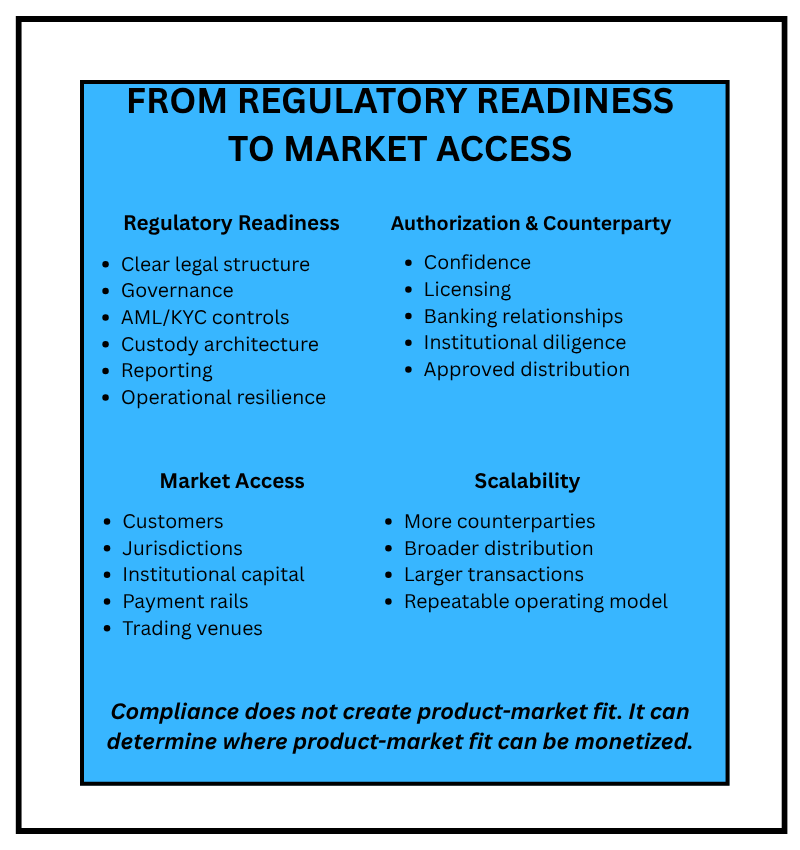
Regulation remains expensive.
Licensing requires legal work. Compliance teams cost money. Capital and reserve requirements tie up resources. Reporting creates operational obligations. Customer due diligence introduces friction. Rules can change while products are still being built.
None of that disappears simply because regulation can have strategic value.
What has changed is the role those capabilities play in an increasingly institutional market.
In the first article in this series, we described the digital asset regulatory stack [I1]: asset classification, payments, intermediaries, AML and sanctions, prudential requirements, and jurisdiction.
For a company operating across several layers of that stack, regulatory readiness is not one document or one license.
It is an organizational capability.
A company that can answer those questions has not necessarily built a better product. It has built a product that more counterparties may be able to use. That is where regulation begins to affect competition.
The most direct example is licensing.
A license is often described as permission to conduct a regulated activity. Commercially, it can be something more: a gateway into a market.
The European Union's Markets in Crypto-Assets Regulation provides a clear example. Under MiCA, firms providing covered crypto-asset services generally require authorization as crypto-asset service providers. Once authorized, a CASP can provide the authorized services throughout the European Union through establishment or cross-border provision without maintaining a physical presence in every host member state. That EU-wide authorization framework turns regulatory approval into a distribution capability.
The requirements are substantial.
Applicants must provide information about governance, prudential safeguards, management, internal controls, money-laundering risk, business continuity, ICT systems, asset segregation, custody policies, trading procedures, and other elements depending on the services being offered. The MiCA authorization requirements make clear that market access is tied to operational capability, not merely filing paperwork.
The United Kingdom is moving toward a similar gateway model through a different regulatory structure.
The FCA's new cryptoasset regime requires firms conducting covered activities to obtain authorization. Existing registrations under older regimes do not automatically convert into authorization under the new framework. The FCA's application window opens September 30, 2026, ahead of the broader regime taking effect in October 2027. Firms operating within scope therefore have to demonstrate that they can meet the new requirements if they want to preserve access to the market.
Regulation in both cases creates costs. It also creates a boundary. Firms capable of crossing that boundary gain access that firms outside it may not have. That is not regulatory compliance as a badge of virtue. It is compliance as a condition of doing business.
A regulatory license is not merely permission to operate. In some markets, it is part of the distribution infrastructure.
Regulators are not the only institutions deciding whether a digital-asset company can participate in financial markets. Counterparties make their own decisions.
A bank considering a relationship with a stablecoin issuer does not evaluate only the software.
An asset manager considering tokenized securities needs confidence in custody, ownership, settlement, transfer restrictions, and regulatory treatment.
An enterprise considering a payment provider will want to know how customer funds are protected, where transaction data resides, how sanctions are handled, and what happens if the provider fails.
A custodian connecting to a new network has to evaluate operational resilience, controls, key management, governance, and legal responsibility.
These questions are part of doing business in institutional finance. Regulatory readiness can make them easier to answer.
A company with clearly defined governance, documented controls, an established custody model, audited reserves where relevant, enforceable legal rights, and a credible compliance program is easier for another regulated institution to evaluate than one that treats those issues as unresolved details.
This is particularly important because institutional counterparties have their own obligations.
A bank cannot simply decide that a technological innovation is useful and ignore the risks attached to providing access to it. An asset manager cannot substitute technical enthusiasm for its responsibilities to investors. A regulated custodian still has to understand what it controls and how client assets are protected.
The relevant competitive advantage is therefore not simply: We comply with the rules.
It is: We are structured so regulated counterparties can work with us.
That is a higher bar. It is also a more commercially useful one.
The strongest version of regulatory readiness goes beyond policies and procedures.
It appears in the product itself.
Consider the requirements that increasingly surround institutional digital assets:
A company can attempt to manage each requirement manually around the edges of a technical system. Or it can design parts of the operating architecture around them. Tokenized securities provide a useful example.
If only certain investors may hold a particular instrument, the system may need a reliable mechanism for establishing investor eligibility before a transfer is permitted.
If legal ownership depends on an authoritative record rather than possession of the token alone, that relationship has to be reflected in the product architecture.
If customer assets must remain segregated, the custody design has to support that requirement.
Those are not merely legal drafting issues. They touch identity, wallets, smart contracts, databases, custody, user experience, and transaction workflows.
Our earlier analysis of the legal architecture of tokenized assets reaches the same conclusion from another direction: technical ownership and legally enforceable ownership do not automatically mean the same thing.
A similar dynamic appears in stablecoins.
The emerging U.S. regime addresses reserves, redemption, custody, risk management, audits, supervision, capital and operational backstops. The OCC has separately proposed AML/CFT and sanctions standards for issuers under its supervision and proposed recurring reporting for payment-stablecoin activity and reserves.
For an issuer, those requirements are not external to the product.
This is the logic behind Compliance-by-Design
Instead of building the product first and asking lawyers how to make it compliant later, regulatory requirements become inputs alongside security, cost, user experience, scalability, and performance.
Digital-asset companies often focus on technical integration.
Institutional partnerships require another kind of integration as well.
Before a bank, payment company, custodian, asset manager, or enterprise commits to a relationship, it may need to understand:
When those questions generate months of uncertainty, the commercial process slows down.
When the answers are already embedded in governance, architecture, documentation, and controls, the conversation can move more quickly toward whether the product itself makes sense.
That does not eliminate diligence. It makes diligence more tractable.
For companies trying to sell into regulated markets, that can be consequential. The ability to satisfy a counterparty's internal legal, compliance, security, risk, and procurement functions may matter nearly as much as satisfying the business unit that wants the product.
A technically impressive solution that cannot clear institutional diligence may never reach production.
Custody is one of the clearest examples.
Digital assets can create a misleading impression that control is technologically simple: whoever holds the private key controls the asset.
Institutions need more than cryptographic control.
They need governance around who can authorize transactions, how keys are protected, how customer property is segregated, how records are reconciled, how recovery works, how legal ownership is established, and how failures are handled.
Our work on institutional custody models for tokenized assets has repeatedly returned to the same point: custody is both technical infrastructure and legal infrastructure.
Regulatory capability can therefore improve the product itself.
A stronger custody architecture may simultaneously satisfy regulatory obligations, make institutional diligence easier, reduce operational uncertainty, and expand the set of counterparties willing to hold or interact with the asset.
Compliance in that case is not simply a cost imposed on custody.
It is one of the characteristics that makes institutional custody possible.
There is another, less obvious advantage to clearer regulation. It can reduce uncertainty about what companies are expected to build.
MiCA offers a useful example.
An applicant seeking authorization knows that regulators will expect information and controls relating to governance, prudential safeguards, risk management, ICT systems, business continuity, client-asset protection and service-specific procedures.
Those obligations are costly. But they are also visible.
Companies can design around them. Investors can diligence them. Counterparties can compare firms against them. Regulators can supervise them.
The alternative—an environment where nobody is certain which rules apply—can appear flexible but create a different commercial cost.
Companies hesitate to invest in products that may have to be rebuilt. Banks hesitate to support activities whose regulatory treatment remains uncertain. Institutional customers hesitate to depend on infrastructure that may later become unavailable. Investors have difficulty estimating regulatory exposure.
Clarity does not remove regulatory risk. It can make some of that risk easier to price. For long-term infrastructure businesses, predictability has economic value.
[VISUAL 2 — PLACE HERE]
Capability
Immediate purpose
Potential business value
Authorization
Permission to perform regulated activity
Market access
Governance & controls
Accountability and risk management
Institutional diligence
AML/KYC infrastructure
Financial-crime compliance
Access to regulated counterparties
Custody architecture
Protect and control customer assets
Institutional participation
Reporting & auditability
Regulatory transparency
Operational credibility
Jurisdictional planning
Match product to local rules
Scalable distribution
Compliance-by-Design
Embed requirements into architecture
Lower retrofit risk
Bottom line:
The value does not come from compliance alone. It comes from the markets, counterparties, and operating models that compliance makes possible.
Regulatory readiness becomes particularly valuable when the alternative is redesign.
Imagine a company that launches a tokenized asset with unrestricted wallet-to-wallet transfers.
Institutional interest arrives.
Only then does the company discover that the target product requires investor eligibility checks, jurisdictional restrictions, custody controls, transaction monitoring, and legally authoritative ownership records.
The problem is no longer limited to adding terms and conditions.
The transfer architecture may need to change.
The onboarding process may need to change.
The custody model may need to change.
The data model may need to change.
The smart contracts may need to change.
The distribution strategy may need to change.
In some cases, the economics of the product change as well.
Stablecoin reserve requirements can affect yield and treasury strategy. Capital requirements can affect returns. Segregation rules can constrain how assets are used. Reporting obligations can create systems costs. Licensing requirements can determine which markets justify entering at all.
Compliance-by-Design does not eliminate those costs. It makes them visible earlier.
That can prevent a company from optimizing a product for a market it cannot legally serve—or from building an architecture that has to be dismantled once institutional customers arrive.
There is a danger in taking the argument too far.
Regulatory readiness is not the same thing as competitive superiority.
A licensed business can have a poor product. A company with excellent compliance controls can charge too much, move too slowly, or fail to attract customers. A technically superior competitor may still outperform it in markets where regulatory access is not a meaningful constraint. Compliance requirements can also reinforce incumbency.
Licenses, legal teams, capital requirements, audits, reporting systems, and specialized personnel cost money. Larger firms can absorb those expenses more easily than startups. Rules intended to reduce risk can therefore raise barriers to entry as well.
MiCA illustrates the tradeoff. Authorization can unlock cross-border access across the EU, but obtaining and maintaining that authorization also requires governance, prudential safeguards, systems, controls, asset-protection measures, and continuing compliance.
The UK's new authorization regime creates a similar dynamic. The FCA explicitly notes that existing registrations do not automatically convert, and firms within scope must satisfy the applicable authorization requirements and continue meeting threshold conditions, rules, reporting requirements, and supervisory expectations once authorized.
Those obligations may strengthen well-prepared firms. They may also make some business models uneconomic.
So the useful claim is not: Regulation creates competitive advantage.
It is narrower: Where regulatory access is necessary for customers, counterparties, products, or markets, regulatory readiness can become a source of competitive advantage.
That qualification is important.
The strategic value of compliance lies less in the rule itself than in the markets, counterparties, and operating models that firm can access because it is ready.
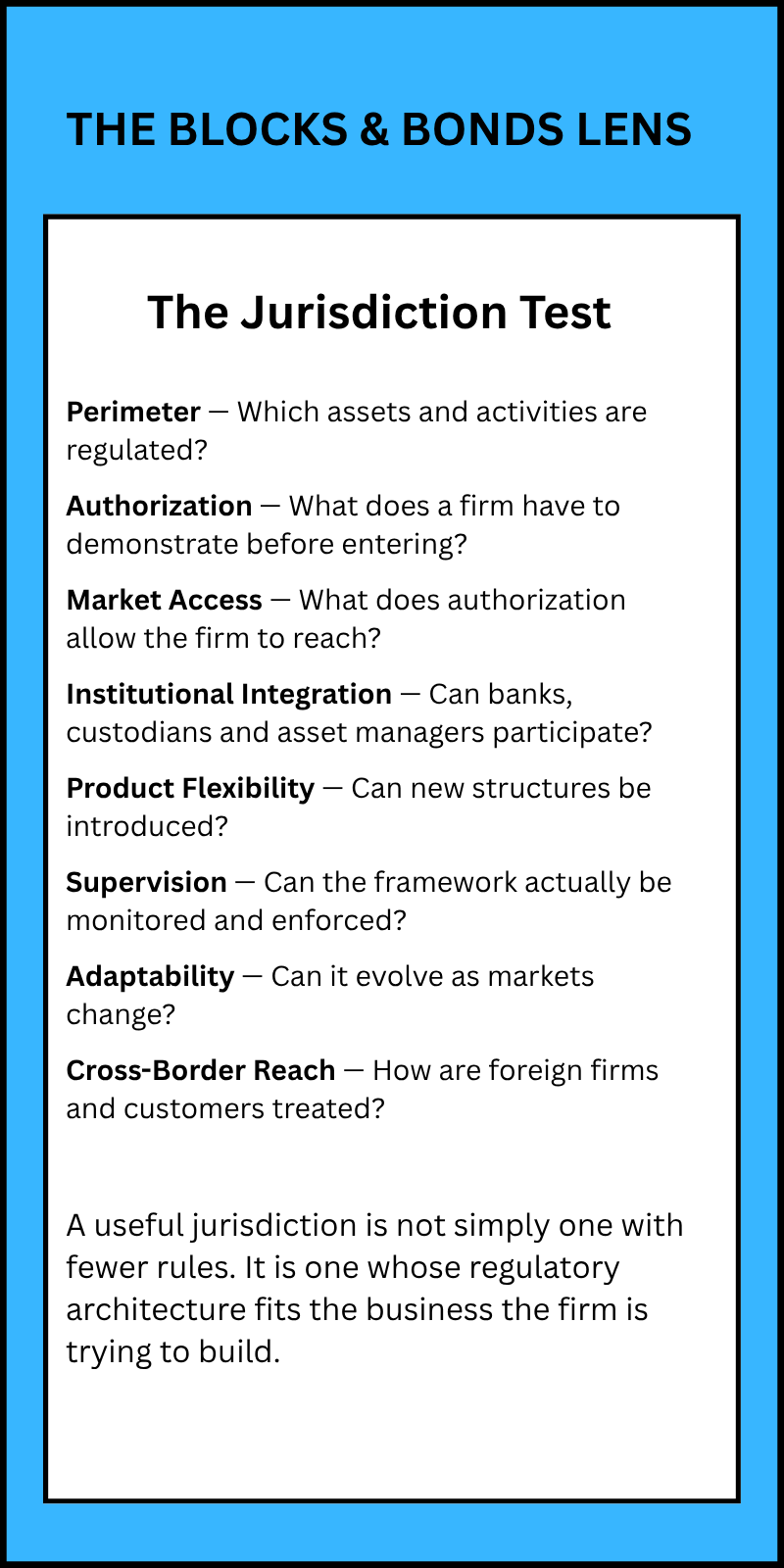
A company claiming to be “regulation-ready” should be able to answer more than whether it has outside counsel.
Ask:
Classification
Can the firm explain what its product legally represents?
Authorization
Does it know which regulated activities it performs and which licenses they require?
Architecture
Are relevant compliance requirements reflected in the product, custody, and transaction design?
Counterparties
Can banks, custodians, asset managers, and enterprise customers diligence the business efficiently?
Operations
Can the company produce the records, controls, reports, and audit evidence required at scale?
Jurisdiction
Does it know where the product may be distributed and where restrictions apply?
Adaptability
Can the architecture accommodate changing regulatory requirements without rebuilding the product?
A company does not need the same answer at every stage of development. It needs to know which answers are necessary for the market it is trying to enter.
Digital-asset markets are moving into an awkward middle period. The technology remains capable of global, permissionless movement. The institutions increasingly interacting with it are not permissionless.
Banks operate within regulatory perimeters. Asset managers owe duties to investors. Payment firms require licenses. Custodians must protect customer property. Large enterprises have compliance and risk functions.
Capital markets depend on enforceable rights, identifiable counterparties, and operating rules that survive when something goes wrong.
Connecting blockchain infrastructure to those institutions therefore requires more than making the technology work.
The surrounding organization has to work as well. That means knowing which rules attach to the product. Building controls that match the activity. Creating an operating model that can survive institutional scrutiny. Choosing jurisdictions deliberately. And treating legal and compliance architecture as part of the product rather than documentation prepared after it.
The companies that do this well will not automatically win. But they may gain something increasingly scarce in digital finance: the ability to move from technical possibility to institutional participation.
That is the deeper competitive value of regulatory readiness.
The next question operates at a larger scale.
If regulatory architecture can shape which firms gain access to markets, it can also shape which jurisdictions attract those firms in the first place.
That is where the final article in this series turns next.
September 24, 2026
12 minutes