April 26, 2026
4 minutes

August 30, 2026
10–12 minutes
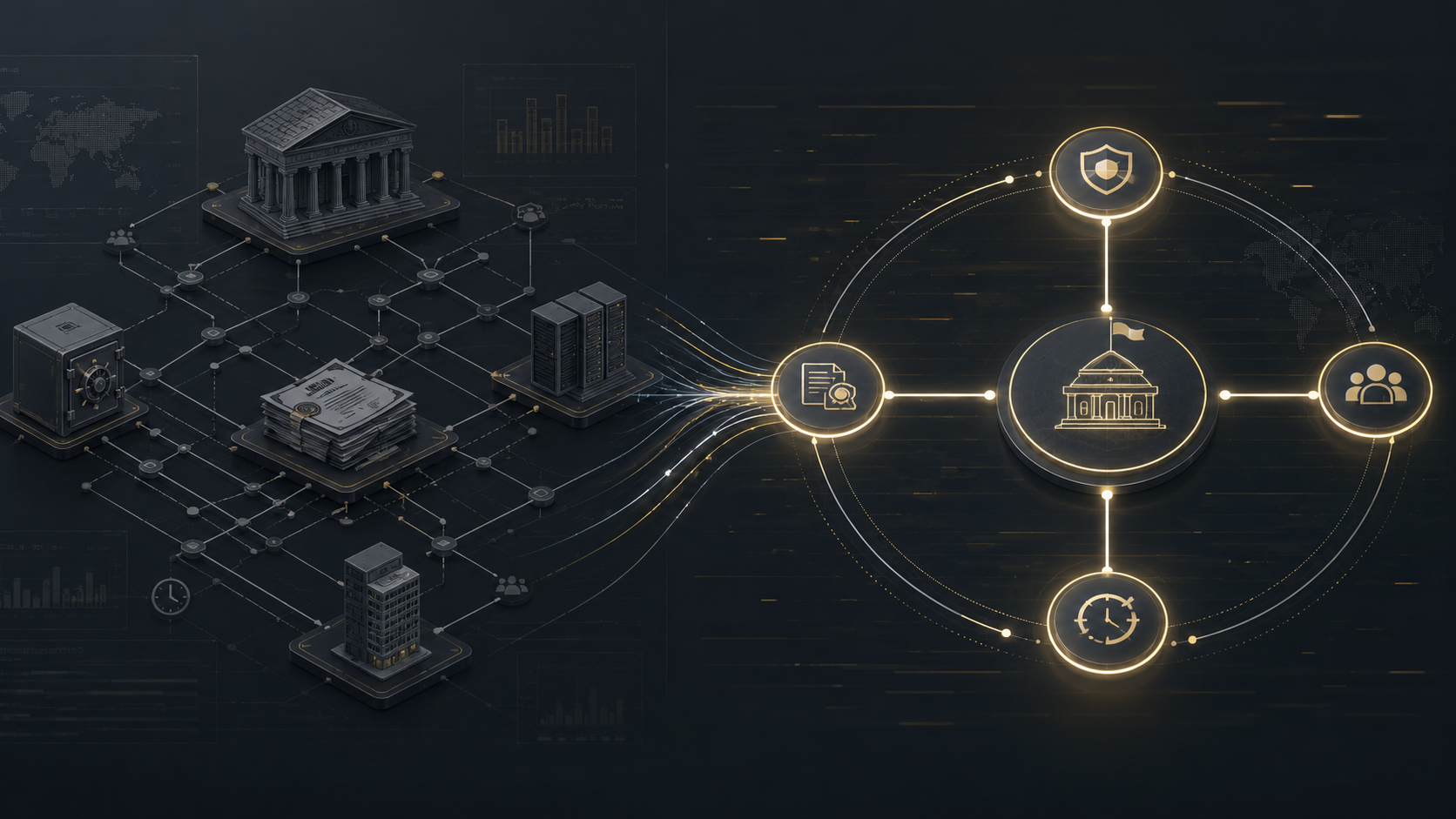
Tokenization can make an asset transferable. That does not make it liquid. The distinction is becoming increasingly important as tokenized securities move from experiments into functioning financial products.
Treasuries, money-market funds, private credit, equities, commodities, and other real-world assets are now being represented on blockchain networks. By August 2026, distributed tokenized real-world assets had reached roughly $38 billion, excluding stablecoins, while the number of holders continued to expand.
Those numbers demonstrate that tokenization is gaining traction. They do not demonstrate that tokenized markets are liquid. In fact, secondary-market liquidity remains one of the largest unresolved problems in the development of tokenized finance.
That is not a failure of blockchain technology. It reflects a more fundamental truth about financial markets: Liquidity is not a technological feature. It is an economic outcome.
A blockchain can improve the mechanics surrounding an asset.
None of those capabilities automatically creates a buyer. That is the key difference.
Liquidity exists when market participants can reliably buy or sell an asset in meaningful size, with limited price impact, at a price that reflects available information. Creating a token does not create those conditions.
The World Economic Forum highlighted the problem in its 2025 study of asset tokenization. Despite more than $15 billion in tokenized fixed-income issuance at the time, nearly half of the initiatives examined reported turnover below $1 million. The technology had successfully created tokenized instruments. Secondary trading remained thin.
The gap between issuance and trading is one of the defining features of today’s tokenization market.
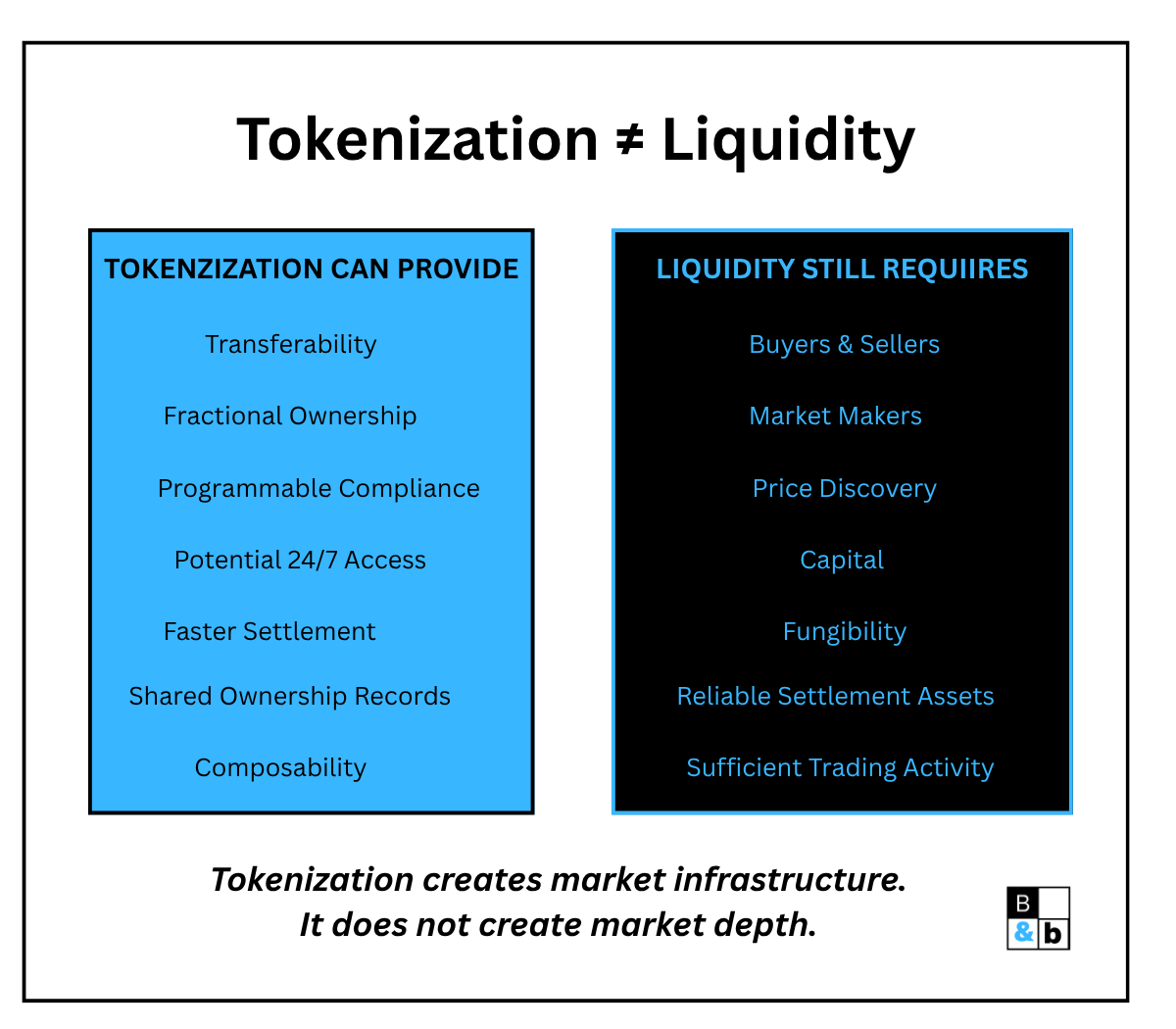
There are good reasons tokenization can gain adoption before deep secondary markets emerge.
None of those benefits requires a continuously traded secondary market. This is one reason measures of “tokenized asset value” must be interpreted carefully.
RWA.xyz now distinguishes between distributed assets, which can move beyond the issuing platform and between wallets, and represented assets, where blockchain primarily provides an ownership or recordkeeping layer.bThat is a key difference. An asset can be meaningfully tokenized without being meaningfully liquid. The market is discovering that those are separate stages of development.
Traditional capital markets benefit from enormous concentrations of infrastructure and participants.
Large public equities trade through established venues. Market makers continuously quote prices. Brokers aggregate orders. Institutional investors provide large pools of capital. Securities can often be financed, lent, pledged, or hedged.
Market makers may have little economic incentive to commit capital to an asset with minimal expected turnover. Even when two tokenized products provide exposure to essentially the same underlying asset, they may exist inside separate liquidity pools.
Blockchain makes assets easier to move. Fragmented market structure can still make them difficult to trade.
There is another reason tokenized assets cannot be treated like ordinary crypto tokens. The token is not necessarily the asset. It represents a legal or economic claim whose structure can vary significantly.
The SEC's January 2026 statement on tokenized securities explicitly distinguished among different models, including securities tokenized by the issuer and tokens created by third parties representing interests tied to existing securities. Different structures may give investors different rights even when the underlying economic exposure appears similar.
That matters enormously for secondary markets. A market maker needs to understand what it is pricing.
Two tokens tracking the same stock are not necessarily interchangeable if their legal structures differ. Without fungibility, liquidity fragments.
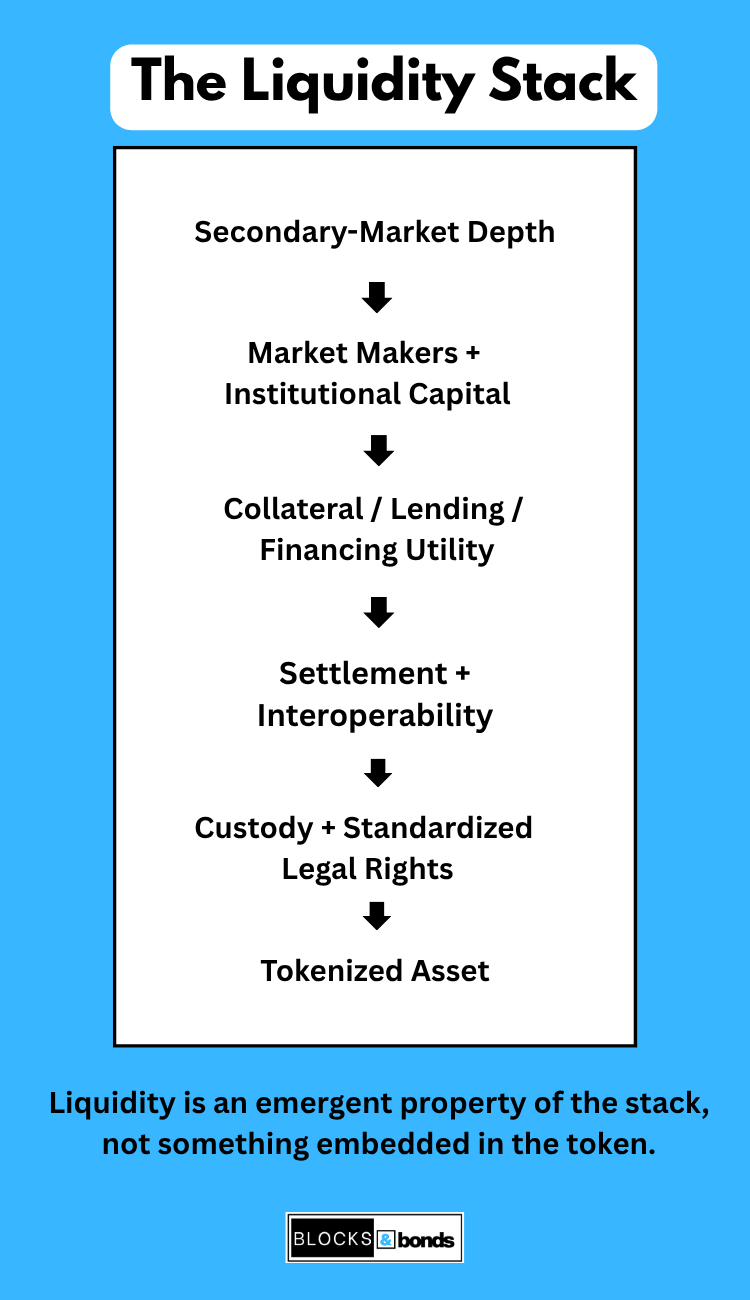
Secondary markets require more than a tokenized asset. They also require money. If an asset trades continuously but the payment leg cannot, the market remains constrained. This is where stablecoins and tokenized deposits intersect directly with the liquidity question.
An on-chain security paired with an on-chain settlement asset allows both sides of a transaction to operate within compatible infrastructure. That can support faster delivery-versus-payment settlement and make capital available for reuse more quickly. Over time, this matters for market makers.
Capital trapped in lengthy settlement cycles is capital that cannot immediately support another trade. Faster settlement can reduce some of that friction. But faster settlement also changes liquidity management. Traditional settlement cycles provide time to assemble cash and securities. Near-instant settlement can require participants to maintain assets and cash where they are needed before the trade occurs.
Tokenization can therefore reduce settlement risk while increasing the importance of real-time liquidity management. Again, technology changes the structure of the problem rather than eliminating it.
None of this means tokenization has little effect on secondary markets. Quite the opposite. It means the mechanism is more subtle than “put asset on blockchain, liquidity increases.” Tokenization can lower several barriers that inhibit liquidity.
Assets can potentially trade beyond conventional market hours. Smaller denominations can broaden access. Common settlement infrastructure can reduce friction between venues. Programmable compliance can make transfer restrictions easier to administer. Transparent ledgers can improve visibility into ownership and transactions. Assets can potentially be used as collateral across other applications.
Most importantly, tokenization can make an asset more useful after it is issued. That may ultimately become one of the strongest sources of liquidity. A Treasury token that can only be held is one product.
A Treasury token that can be transferred, pledged as collateral, deposited into a lending protocol, used as margin, exchanged against stablecoins, and integrated into treasury-management systems is something different. Its liquidity is supported not merely by speculative demand but by financial utility.
This is already becoming visible in the RWA market, where tokenized assets are increasingly being integrated into lending, margin, reserves, and yield applications. Recent research estimates that distributed non-stablecoin RWAs have grown substantially faster than the broader tokenization universe as assets become usable within on-chain financial infrastructure. Composability may eventually matter more for liquidity than fractionalization.
One of the most important developments in 2026 has been the movement of established market infrastructure into tokenization.
In July, DTCC successfully processed production trades involving securities converted into DTC-tokenized assets, ahead of a planned October launch of its tokenization service. The initiative involves firms spanning asset management, custody, brokerage, trading, banking, crypto infrastructure, and market making.
This is important not simply because a large incumbent is “using blockchain.” DTCC already sits at the center of enormous pools of securities and institutional liquidity. Connecting tokenization to existing pools of assets, participants, custody, and market infrastructure may prove more consequential than building entirely separate token markets from scratch. The liquidity problem may ultimately be solved through convergence rather than replacement.
There is also a conceptual mistake embedded in some discussions of tokenization. Not every asset is supposed to trade like a public stock. Private credit is private partly because its underwriting, information, and investor base differ from public bonds. Real estate is inherently heterogeneous. Private-equity interests represent long-term investments in businesses that cannot be repriced continuously with perfect information.
Tokenizing those assets does not remove their underlying economics. It may reduce administrative friction around transferring them. It may broaden the eligible investor pool. It may make smaller positions practical. It may create periodic secondary-market opportunities. But forcing continuous liquidity onto inherently illiquid assets can create its own risks.
The goal should not necessarily be to make every asset trade every second. It should be to make liquidity available where it is economically useful and legally appropriate.
Tokenized assets will probably not develop one universal secondary market. Instead, liquidity is likely to concentrate around certain characteristics.
Assets with standardized rights, widely accepted custody, strong issuer credibility, broad investor eligibility, reliable pricing, established settlement assets, and multiple uses as collateral are likely to develop deeper markets first.
This helps explain why tokenized Treasuries have become one of the strongest early RWA categories. The underlying asset is already standardized, liquid, well understood, and widely demanded.
Tokenization adds new distribution and settlement capabilities without asking investors to learn an entirely new economic product. Other asset classes face a longer road.
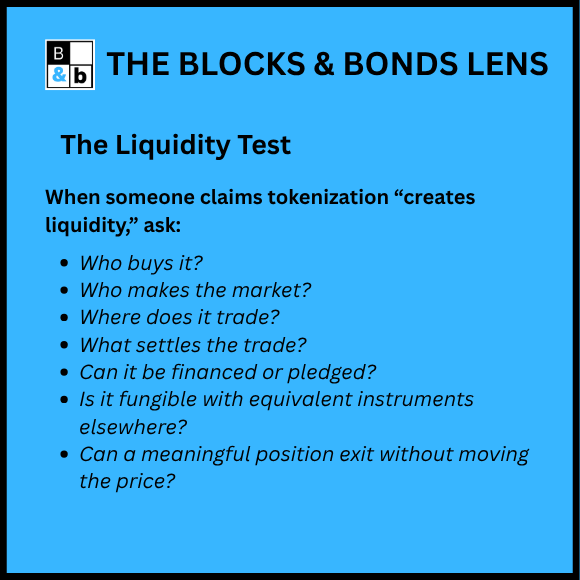
The growth of tokenized assets is real. So is the liquidity problem. Those facts are not contradictory.
Financial infrastructure often develops in stages. Assets are digitized. Issuance grows. Custody systems develop. Settlement improves. Standards emerge. Market makers arrive. Collateral networks form. Secondary markets deepen.
Tokenization appears to be following that progression. The mistake is expecting the first stage to automatically produce the last.
Blockchain can reduce friction. It can make assets programmable. It can connect ownership and settlement. It can broaden distribution. It can allow assets to interact with an entirely new financial ecosystem. But liquidity ultimately comes from market participants willing to deploy capital.
The next phase of tokenized finance will therefore be measured by more than how many assets move on-chain. The more important question is whether those assets can move through markets once they get there.