
June 11, 2026
16 minutes
October 11, 2026
10 minutes
One of blockchain's most appealing characteristics is that participants can independently verify what has happened on the ledger.
Those facts can be established by the network itself. But most financial transactions depend on information the blockchain cannot independently know.
These are not merely blockchain questions. They are questions about the world outside the ledger. And as financial transactions become increasingly programmable, the ability to answer those questions reliably becomes critical.
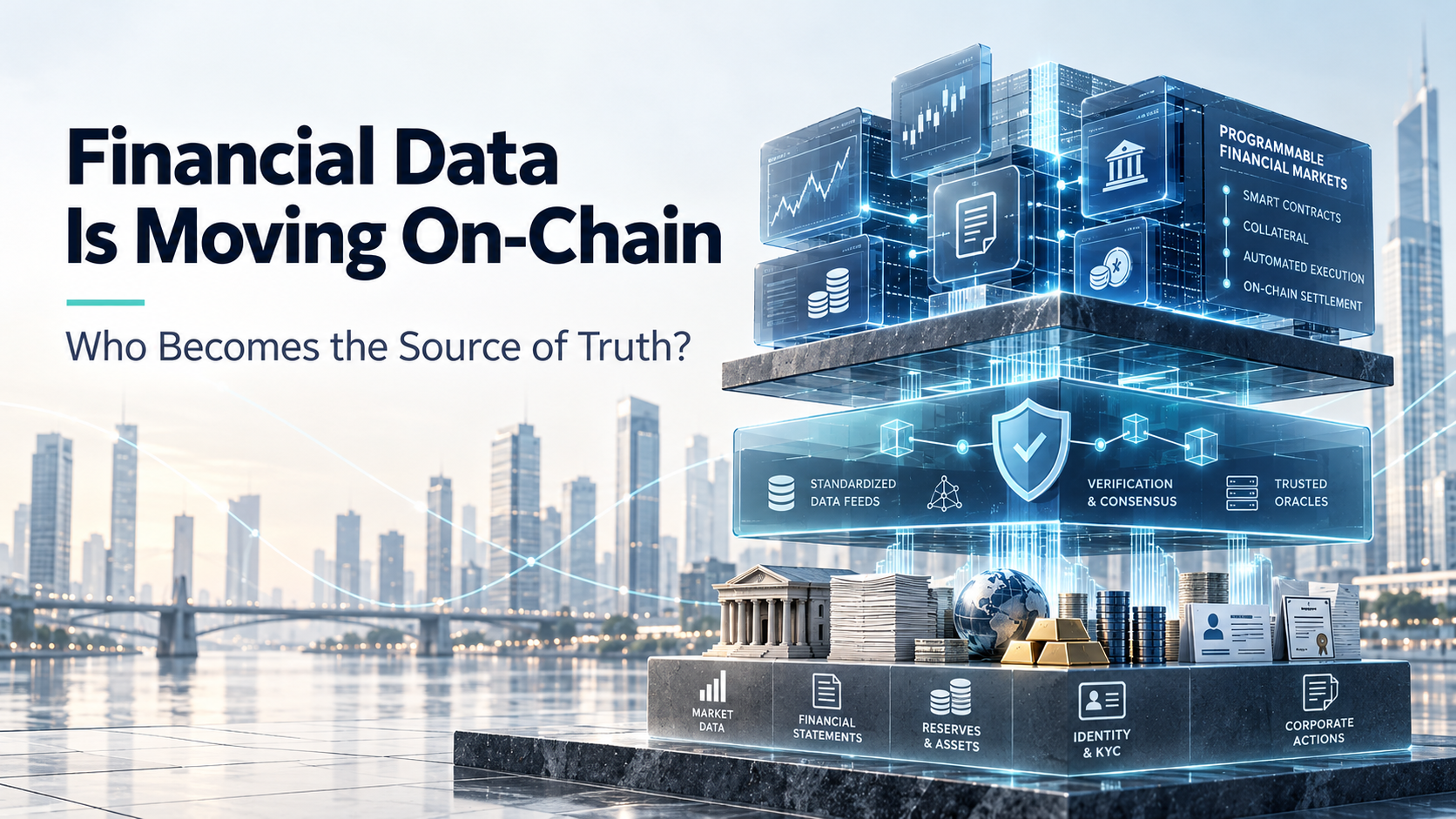
A smart contract can execute automatically. It cannot independently determine whether the information triggering that execution is correct. That creates one of the central infrastructure problems of tokenized finance: If markets increasingly run on code, who tells the code what is true? As we outlined in the institutional digital asset stack, data and oracles sit between the external financial world and the programmable systems increasingly expected to act on it.
The distinction is important. A blockchain can provide strong assurances about information generated inside its own system.
If a wallet contains 1,000 tokens, the network can verify that state. If 100 tokens move from one wallet to another, the network can verify the transaction. But a blockchain cannot inherently verify that those tokens correspond to 100 shares in a legally constituted investment fund. Nor can it independently determine the value of those shares.
The underlying information must come from somewhere else. This is commonly described as the oracle problem.
An oracle delivers information from outside a blockchain to applications operating on it. That information may include asset prices, interest rates, exchange rates or other data required for a smart contract to function.
The International Monetary Fund describes oracles as services delivering off-chain information to smart contracts and notes that they can become critical inputs for functions such as risk calculations, margin calls and derivatives settlement. If the data is incorrect or manipulated, the contract may execute incorrectly as well.
But in institutional finance, the issue extends well beyond conventional price oracles.
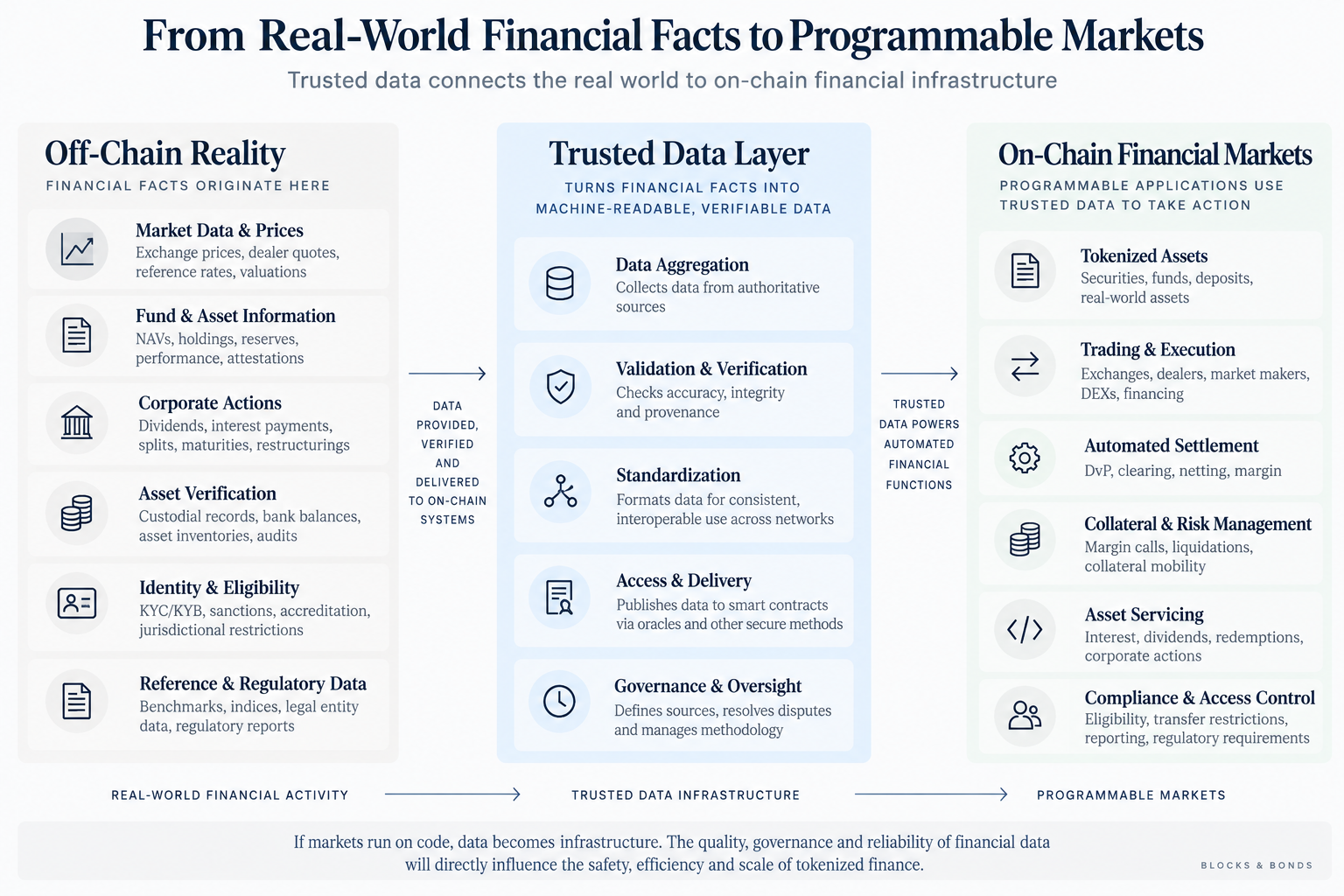
The emerging requirement is closer to a financial truth layer. That layer must connect legal ownership, market prices, corporate actions, identity, reserves, accounting information and other off-chain facts with financial systems increasingly capable of acting automatically.
Traditional financial markets already depend heavily on data.
The difference is that much of the data infrastructure sits in the background.
Institutions consume those facts and incorporate them into their own systems.
That architecture can be slow, fragmented and operationally expensive, but it also contains layers of review, reconciliation and human intervention.
Programmable finance can compress those processes.
The IMF has argued that tokenized finance may shift more financial processes toward data feeds, algorithms and code, potentially enabling settlement, collateral management and reporting functions to operate automatically.
That can increase efficiency. But it also means the quality of the data becomes directly connected to the quality of the financial outcome.
In traditional markets, bad data may produce a reconciliation problem. In programmable markets, bad data may produce an immediate transaction. That is a fundamentally different risk.
The crypto market's earliest oracle requirements were relatively straightforward.
A decentralized lending protocol needed to know the price of ETH.
A derivatives platform needed the price of Bitcoin.
A stablecoin protocol needed the value of its collateral.
Those use cases remain important. Institutional tokenization introduces a much broader set of information requirements.
Consider a tokenized money-market fund.
The fund may exist on a blockchain. Its shares may move between eligible investors. But the blockchain still needs to know the fund's NAV. That calculation may depend on securities prices, accrued interest, cash balances, fees and other accounting inputs maintained elsewhere. This is not theoretical.
DTCC's Smart NAV pilot examined how standardized mutual-fund price and rate data could be delivered onto distributed ledgers. Working with Chainlink and ten market participants, DTCC tested whether its existing fund data could become a reusable on-chain data service.
The pilot concluded that structured NAV information could support tokenized funds and other smart-contract applications across multiple blockchain environments.
The significance is larger than the pilot itself. DTCC was not attempting to replace the fund administrator or invent a new asset price. It was examining how an existing trusted financial data function could become available to programmable markets.
That may be a useful model for how institutional tokenization develops. The source of truth does not necessarily disappear. Its information becomes machine-readable and accessible to new financial infrastructure.
Tokenized assets also need reliable valuation.
But pricing can become complicated quickly.
These issues already exist in conventional finance. Moving execution onto a blockchain does not resolve them. It may make their resolution more consequential because the resulting value can directly activate automated financial logic.
Stablecoins and tokenized real-world assets introduce another class of information problem.
The blockchain can show that one billion tokens exist. It cannot prove that one billion dollars of corresponding assets exist somewhere else. The ledger can verify the token. It cannot automatically verify the reserve.
That requires some combination of:
The same issue applies to tokenized real-world assets.
A blockchain may accurately record ownership of a token representing a Treasury security. But investors still need confidence that the underlying security exists, is properly segregated and legally corresponds to the token.
This is one reason the phrase "on-chain transparency" can be misleading.
Blockchain transparency can be extremely useful. But it generally provides transparency into what is happening on the blockchain. It does not automatically make the external world transparent. That boundary is where trusted data infrastructure becomes essential.
Tokenized securities also retain the economic life cycle of the securities they represent.
These events must somehow be communicated to the systems maintaining the tokenized asset.
Consider a simple dividend. A smart contract may be perfectly capable of automatically distributing payments to every eligible tokenholder.
But someone—or some authoritative system—must determine:
Automation occurs after authoritative information enters the system.
That distinction matters. Tokenization may automate asset servicing. It does not eliminate the need for the information that makes asset servicing possible.
Institutional financial markets require more than market information. They require information about participants.
These are data questions.
A blockchain address by itself generally does not answer them. That means tokenized financial systems will increasingly need mechanisms connecting digital identities or credentials with blockchain addresses.
Importantly, this does not necessarily require publishing personal information onto a public blockchain. Systems can potentially verify that a condition has been satisfied without revealing all of the underlying information.
The important point is architectural: Institutional markets need trusted identity information just as much as they need trusted prices.
If compliance becomes programmable, identity data becomes part of market infrastructure.
It is tempting to treat all of this as a technical challenge.
Those approaches matter. But institutional finance introduces a deeper question.
Who is authorized to define the truth?
Suppose five different data sources publish different valuations for an asset. The technical system can aggregate them. But someone still needs to decide which sources qualify for inclusion.
Suppose a corporate issuer disputes an event supplied to a blockchain. Who resolves the disagreement?
Suppose a NAV calculation is incorrect. Can the transaction be reversed?
Suppose an oracle fails during a market shock. Should automated liquidations continue?
These are questions of governance.
Recent IMF research on tokenized financial-market infrastructure makes an important distinction between functions that can increasingly be performed by code and functions that continue to require institutional judgment, accountability and legal authority. The likely result is a hybrid infrastructure in which technology performs more operational functions while institutions continue to provide governance and trust.
That is particularly relevant to financial data.
The future source of truth may not be a single institution. But neither is it likely to be simply "the blockchain."
Instead, trust may be distributed among:
The challenge is determining how those layers interact.
This creates a potentially important strategic battleground.
Several different types of organizations can compete for control of the data layer.
Organizations such as DTCC already sit close to authoritative financial records and standardized industry data.
Their advantage is institutional trust. They understand securities infrastructure, regulated market participants and existing financial workflows.
The Smart NAV pilot illustrates how these organizations might extend their existing role into tokenized markets rather than surrendering it to blockchain-native providers.
Established market-data firms already distribute prices, reference data, benchmarks and analytics throughout the financial system.
Tokenization creates another delivery environment rather than eliminating their underlying value. If smart contracts need institutional-quality financial data, firms already trusted by banks and asset managers have a significant starting advantage.
Oracle networks bring a different capability. They are designed to make external information available to smart contracts across blockchain environments.
Their strategic opportunity is to become an abstraction layer between traditional data providers and programmable finance. The value may therefore lie less in creating the data than in reliably delivering and verifying it across networks.
Some institutions will remain authoritative sources for information about the assets they administer.
A custodian may be the most credible source regarding assets in custody.
An asset manager may remain responsible for fund information.
A bank may attest to deposit balances or tokenized liabilities.
Tokenization could therefore turn institutions traditionally viewed as intermediaries into data publishers for programmable markets.
There may also be an emerging market for cryptographic proof and verification. Proof-of-reserves systems are an early example.
Future systems could allow institutions to prove that particular assets, balances or compliance conditions exist without necessarily exposing the full underlying dataset publicly. This could create an entirely new category of financial infrastructure.
The crypto industry's traditional oracle debate often centers on decentralization.
Those questions remain important. But institutional markets may care equally about standardization.
A financial system cannot operate efficiently if every tokenized fund publishes NAV information differently.
The DTCC Smart NAV pilot is instructive precisely because it focused on creating structured data that could be reused across blockchain environments.
That suggests an important possibility. The most valuable financial-data infrastructure may not be the system that produces the most decentralized data feed.
It may be the system that makes trusted information standardized, interoperable and machine-readable. In institutional finance, interoperability often creates more value than novelty.
As more financial functions become automated, data failures may also become systemic.
Imagine a widely used pricing oracle incorrectly reporting the value of a major collateral asset.
If dozens of institutions and protocols rely on the same feed, they may all react simultaneously.
The IMF has warned more broadly that tokenized markets may shift certain risks away from individual balance sheets and toward the platforms, code and services underlying financial transactions.
Data infrastructure fits directly into that concern. If the same data provider or oracle becomes embedded across many markets, it may become a critical financial node.
That creates a paradox. Standardization and shared infrastructure can improve efficiency. They can also create concentration. The source of truth can become a source of systemic risk.
One of the promises of blockchain technology is reduced dependence on trusted intermediaries.
In some areas, that is clearly possible.
But tokenized finance also reveals something fundamental about financial systems:
Not every important fact originates inside the ledger.
Financial markets connect digital records to legal rights, physical assets, corporate decisions, identities and economic conditions. Those relationships cannot always be established through consensus among blockchain nodes.
Someone—or some trusted process—must connect the ledger to reality. The architecture of trust therefore changes rather than disappears.
This has significant implications for the companies competing to build tokenized finance.
The largest opportunities may not exist only in issuing tokens, building blockchains or operating exchanges. They may also exist in becoming the infrastructure responsible for answering questions such as:
Once financial contracts can act automatically on those answers, providing them becomes an extraordinarily important role.
The next generation of financial infrastructure may therefore include a new class of institutions sitting between facts and execution.
But their function will be essential.
The movement of financial assets onto programmable infrastructure is often described as a story about tokens.
It may ultimately be just as much a story about data.
The crucial infrastructure question is therefore not simply: What moves on-chain?
It is: What information must follow it—and who will the market trust to provide that information?
In traditional finance, control over authoritative data has long been a source of institutional power. Tokenization is unlikely to change that. It may make that power even more important.
Trusted data becomes even more consequential when financial contracts can automatically lend, liquidate collateral, and settle transactions.
Next: Institutional DeFi Is Emerging — But It Doesn't Look Like 2021 DeFi
October 11, 2026
10 minutes