April 26, 2026
3 minutes

October 12, 2026
11 minutes
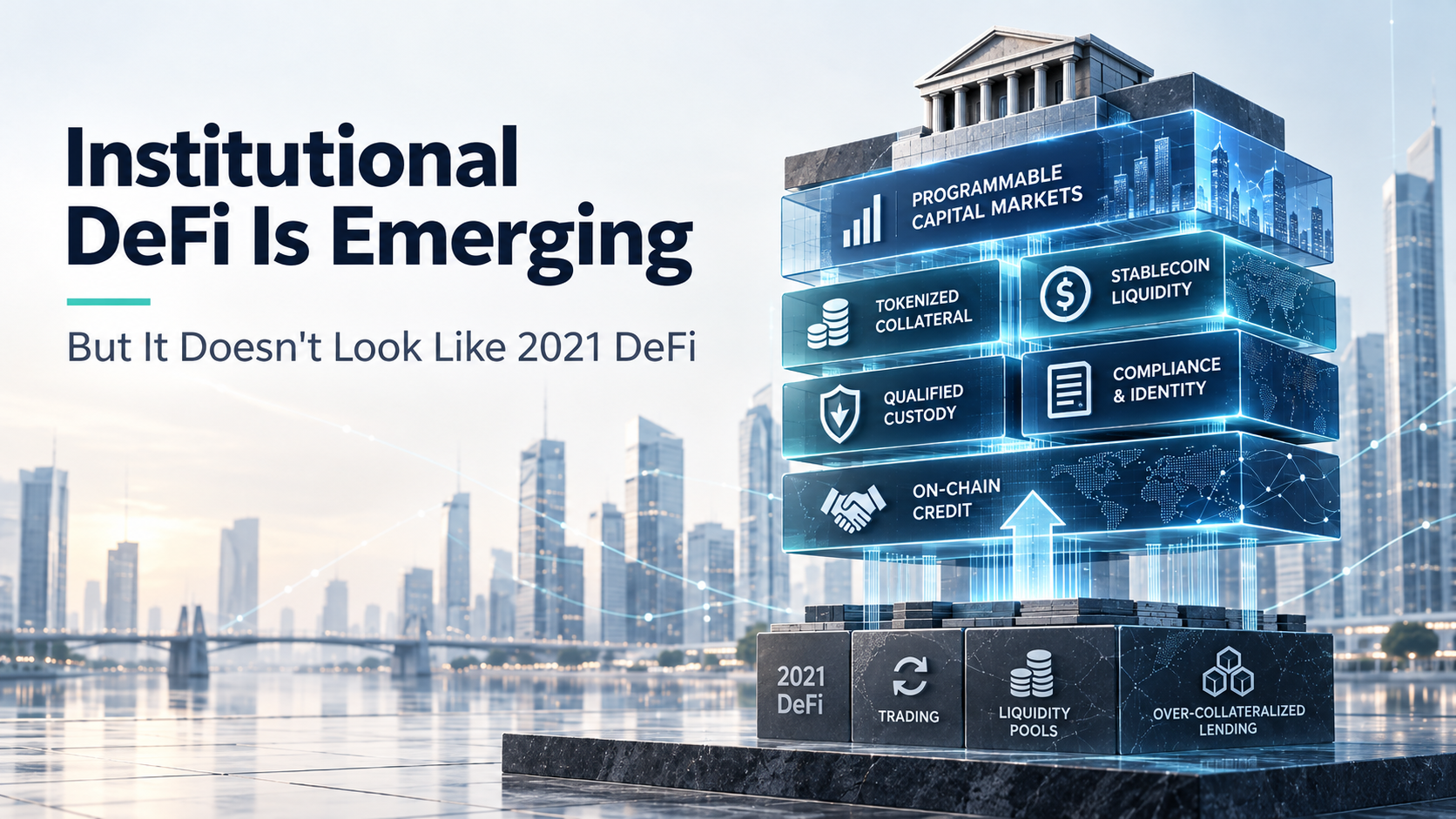
For many financial institutions, the term DeFi still evokes a particular moment.
Crypto holders deposited tokens into anonymous protocols. Automated market makers replaced traditional exchanges. Liquidity mining programs distributed governance tokens. Borrowers pledged volatile cryptoassets against stablecoin loans. Capital moved rapidly between protocols in pursuit of double- and sometimes triple-digit yields.
By 2021, decentralized finance had become one of the clearest demonstrations that financial functions could be recreated using smart contracts.
It was also an ecosystem built largely outside institutional finance. That is significant because the next version of DeFi is beginning to look considerably different.
Institutional-quality credit is moving on-chain. Tokenized Treasury products and other real-world assets are becoming usable as collateral. Qualified custodians are connecting clients to blockchain lending markets. Risk managers and professional asset managers are curating lending pools. Permissioning can exist alongside permissionless liquidity. Stablecoins increasingly provide the cash leg.
The result is not simply traditional institutions entering the DeFi market that already existed.
The architecture of DeFi itself is evolving.
Aave's Horizon market, for example, allows qualified investors to post permissioned tokenized real-world assets as collateral while borrowing from permissionless stablecoin pools. Aave reported in February 2026 that Horizon had already surpassed $440 million in deposits after launching in August 2025.
Maple Finance, meanwhile, reported $4.8 billion under management in September 2026 across institutional lending and yield strategies, while Morpho has increasingly integrated institutional curators, custody providers and tokenized assets into its lending infrastructure.
These markets still use smart contracts, blockchain settlement and composable financial infrastructure. But the institutional version of DeFi is beginning to resemble something different:
regulated assets + programmable markets + institutional risk controls.
That combination may matter far more to the future of finance than recreating the speculative DeFi cycle of 2021.
It is easy to mistake DeFi's first applications for its ultimate purpose.
The early ecosystem produced decentralized exchanges, lending protocols, derivatives markets, stablecoins and automated asset-management strategies. But the deeper innovation was not yield farming.
It was the creation of programmable financial primitives.
A smart contract could:
Those functions could operate continuously according to predetermined rules.
Traditional finance performs many of the same functions, but usually across separate organizations, databases and operational systems. A loan may involve a bank, custodian, collateral agent, payment network, data provider and multiple internal control systems.
DeFi demonstrated that at least some of this financial logic could instead be embedded directly into shared infrastructure. That idea survived the collapse of the speculative excess surrounding it. And institutions are increasingly experimenting with the underlying mechanism.
The IMF now describes programmability as one of the defining characteristics of tokenized finance: smart contracts can automatically execute financial functions including margin calls, collateral transfers and payments. The significance is structural because financial logic moves from a sequence of operational processes toward infrastructure capable of executing the logic itself.
The important question is therefore no longer whether institutions will embrace "DeFi" as the industry understood it in 2021. It is which parts of decentralized financial architecture will become incorporated into institutional markets.
Early DeFi was overwhelmingly crypto-collateralized. Borrowers deposited ETH, wrapped Bitcoin or other digital assets and borrowed stablecoins against them. That model demonstrated the mechanics of programmable lending but constrained the market. The pool of acceptable collateral was largely disconnected from the enormous stock of conventional financial assets held by institutions. Tokenization changes that equation.
Government securities, money-market funds, private credit and other traditional assets can increasingly exist in tokenized form. Once they do, they can potentially interact with programmable lending markets.
Aave Horizon illustrates the model.
Qualified participants can supply tokenized real-world assets as collateral while borrowing stablecoins. Access to regulated collateral remains permissioned according to the requirements of the asset issuer, while the stablecoin liquidity side can remain permissionless.
That hybrid design is important. It suggests that institutional DeFi does not necessarily require choosing between: permissionless DeFi
And fully closed institutional systems.
A September 2026 analysis of the RWA collateral market estimated that roughly $2.1 billion of tokenized real-world assets was already being deployed in DeFi lending markets, even though that represented only about 6% of outstanding tokenized RWA supply.
That gap is important. Much of tokenization's first phase has focused on issuance. The next phase is about making those assets financially useful. An asset that can serve as collateral becomes much more valuable to a financial system than one that can merely sit in a wallet.
This exposes one of the central limitations of the early tokenization market.
Putting a Treasury fund on a blockchain does not automatically create a functioning on-chain capital market.
The asset needs:
Traditional financial assets derive much of their utility from what owners can do with them.
Treasury securities are not important merely because investors can hold them.
Tokenized assets will need comparable functionality if they are going to become more than digitally represented investment products. This is why the connection between tokenization and DeFi may be more significant than either market viewed separately.
Tokenization creates programmable assets.
DeFi supplies programmable financial functions.
Connect the two and tokenized assets can become collateral, borrowing instruments, liquidity sources and building blocks for additional financial products.
Aave described this explicitly when launching Horizon: tokenized RWAs had largely remained isolated from DeFi and therefore underutilized as capital. Horizon was designed to let institutions borrow against those assets rather than selling or redeeming them.
That begins to look less like "crypto lending." It begins to look like an emerging collateral market.
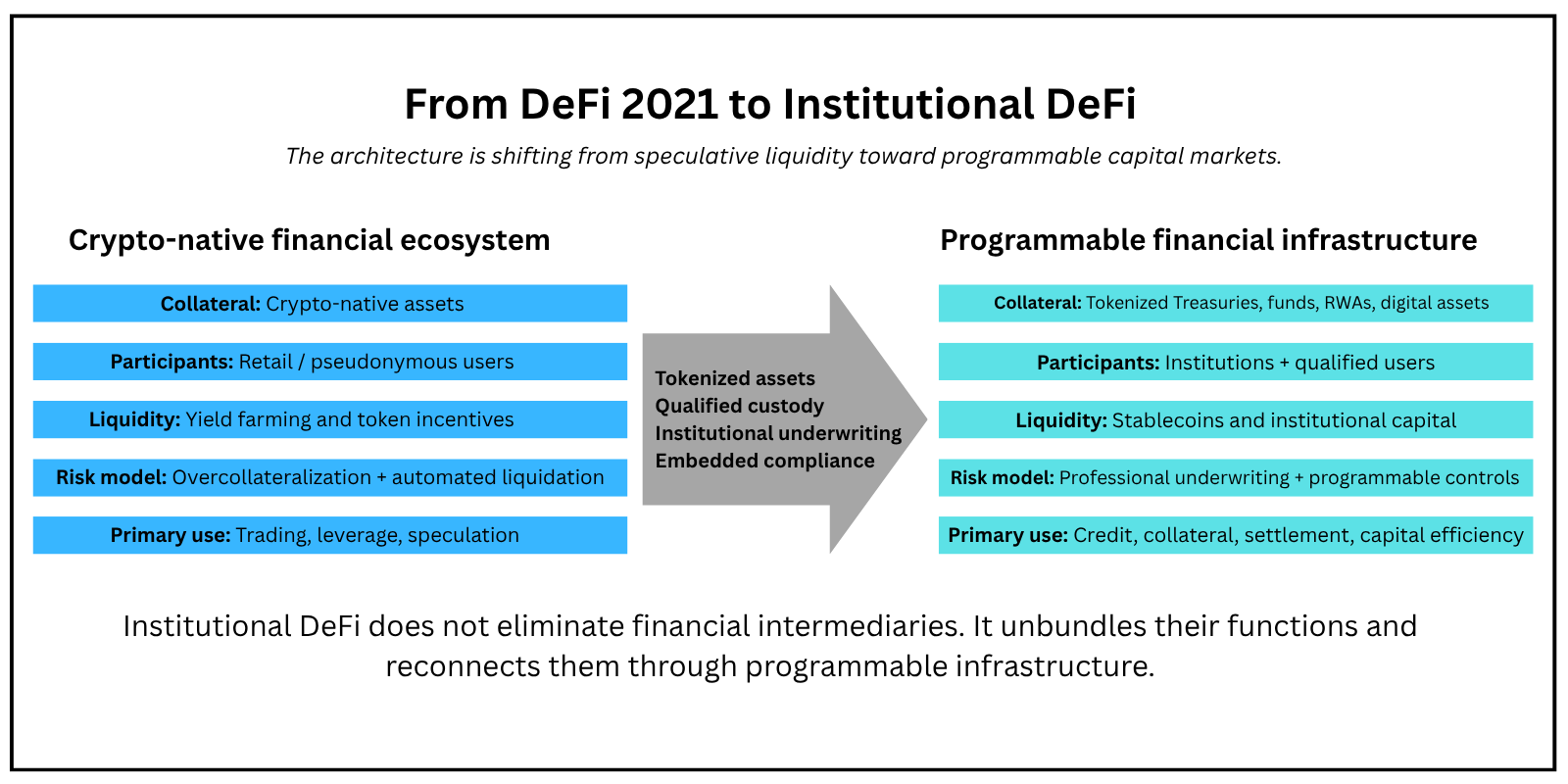
Another change concerns the nature of lending itself. Much of early DeFi lending relied on overcollateralization. A borrower might deposit $150 of cryptoassets to borrow $100.
That structure works when counterparties are pseudonymous because the protocol does not need to assess the borrower's creditworthiness. It protects itself through collateral and automated liquidation. But a large portion of traditional finance operates differently.
Banks and institutional lenders analyze:
Institutional on-chain credit is increasingly incorporating those disciplines.
Maple represents one version of this evolution.
Rather than treating lending as an anonymous liquidity pool, Maple describes its current model around institutional underwriting, collateralized positions, counterparty assessment and centralized risk responsibility. In September 2026 it reported more than $4.8 billion of assets under management and strategies spanning secured institutional lending, asset-backed securitization and other institutional credit opportunities.
The distinction is significant. Early DeFi attempted to eliminate much of traditional credit intermediation through collateral and code. The emerging institutional model is discovering that underwriting still has value.
Blockchain infrastructure may make a loan more transparent or programmable. It does not make credit risk disappear.
The result could therefore be a hybrid architecture in which:
humans assess risk;
institutions underwrite credit;
smart contracts administer financial positions;
blockchains provide transparency and settlement.
That is considerably different from the idea that software simply replaces financial intermediaries.
Some intermediaries disappear. Others become more important.
Permissionlessness was one of early DeFi's defining characteristics. Anyone with a compatible wallet could often interact with a protocol.
That openness created extraordinary accessibility and composability. It also creates problems for regulated financial institutions.
A bank or asset manager may need to know:
Institutional DeFi therefore cannot simply ignore identity. But the emerging solution is not necessarily to make every market completely closed.
Instead, permissioning is becoming more granular. Aave Horizon provides one useful example: the tokenized RWA side is restricted to qualified users approved by the asset issuer, while stablecoin liquidity can remain permissionless.
Morpho has similarly been developing architectures in which programmable compliance can be treated as a market parameter rather than requiring an entirely separate financial system.
This suggests a broader principle: Institutional DeFi may be neither fully permissionless nor fully permissioned.
Access controls can attach to particular assets, counterparties or activities. The underlying financial infrastructure can remain programmable. This modularity may prove important.
Institutions do not necessarily need blockchain networks to become replicas of traditional gated financial systems. They need the ability to impose restrictions where restrictions are legally or economically necessary. That is a much more flexible architecture.
Early DeFi generally assumed that users controlled their own wallets. Institutions often cannot operate that way.
Investment mandates, internal risk policies and regulatory requirements can require assets to remain with qualified or approved custodians.
That creates a fundamental integration problem. How can an institution participate in an on-chain lending market if using the protocol requires assets to leave the institution's custody environment?
The infrastructure is beginning to adapt.
In September 2026, Zodia Custody added Maple to its Interchange network, allowing institutional clients to access Maple's on-chain credit markets while collateral remains in segregated Zodia custody wallets.
Morpho has likewise highlighted integrations through institutional custody providers including Anchorage Digital, Taurus and Ledger Enterprise, allowing customers to reach on-chain lending infrastructure through existing custody relationships.
This is exactly the kind of development that may look operationally mundane but is strategically important.
Institutional adoption often depends less on whether a financial product works technologically than whether it fits existing:
The more DeFi integrates with those systems, the less institutions need to choose between their operating requirements and programmable finance.
Early DeFi celebrated the idea that code itself could manage risk. The experience of multiple market cycles has demonstrated the limits of that assumption.
Smart contracts can enforce risk parameters. They cannot determine whether the parameters are sensible.
Someone must decide:
Those are asset-management and risk-management decisions. Institutional DeFi is increasingly formalizing them.
Morpho's architecture, for example, enables third-party curators to construct and manage lending vaults with particular risk mandates. Asset managers and institutional firms can determine where capital is deployed while the underlying protocol supplies execution infrastructure.
Bitwise entered Morpho's vault-curation ecosystem in 2026, reflecting the growing role of professional asset managers in deciding how on-chain capital should be allocated.
Aave Horizon has similarly formalized collateral onboarding around business cases, risk assessments, technical assessments and governance approval.
This is another sign of convergence. The protocol does not replace professional judgment. It operationalizes professional judgment.The institution determines acceptable risk. The infrastructure executes the resulting rules.
Perhaps the most interesting development is that the boundary between DeFi and traditional finance is becoming harder to define.
In September 2026, Aave Labs proposed an "Aave Institutional" business that would make overcollateralized loans to institutional borrowers against Bitcoin and Ether held with qualified custodians. The loans themselves would be made primarily in stablecoins.
Consider what that represents. The collateral can remain with a conventional qualified custodian. The borrower is identified. Credit is negotiated institutionally. The capital can come from a decentralized protocol ecosystem. Stablecoins provide funding. Governance can involve a DAO.
Is that DeFi? Institutional lending? Crypto prime brokerage? On-chain credit?
The labels begin to matter less than the architecture.
The more consequential development is that components historically divided between decentralized and traditional finance are being recombined.
Custody can be off-chain.
Capital can originate on-chain.
Collateral can be tokenized or conventionally held.
Settlement can use stablecoins.
Risk can be professionally underwritten.
Governance can involve decentralized protocols.
The financial product becomes hybrid.
That may be the actual direction of institutional DeFi.
This shift also changes the economic purpose of DeFi. Much of the 2021 ecosystem was reflexive.
Institutional DeFi has the potential to connect programmable finance with a much larger economic base.
That could include:
Maple, for example, has expanded from crypto-native lending toward institutional credit and asset-backed strategies. Its partnership with Aave is explicitly designed to connect institutional assets with large on-chain liquidity pools.
That is a fundamentally different growth path. Instead of asking how much crypto capital DeFi can attract, the question becomes: How much conventional financial activity can programmable credit infrastructure support?
That market is considerably larger.
The institutionalization of DeFi does not mean its original advantages disappear. One of the most important remains composability.
Financial protocols can interact with other assets and applications through standardized programmable interfaces.
A tokenized asset can potentially become:
This ability to combine financial functions programmatically is difficult to reproduce across today's fragmented institutional systems. It is also why institutional DeFi may offer more than merely cheaper back-office technology.
If assets and financial functions can operate within interoperable programmable environments, institutions may be able to construct new capital structures more rapidly. But composability creates corresponding risks.
If multiple protocols depend on the same collateral, oracle or liquidity source, stress in one component can propagate rapidly throughout the system.
The IMF has warned that tokenization can move risk from individual institutional balance sheets toward infrastructure, code and shared platforms. Automated collateral calls and continuous settlement may improve efficiency in normal conditions while accelerating liquidity demands during periods of stress.
The same programmability that makes institutional DeFi powerful can make interconnected markets more fragile.
Another institutional challenge is continuous operation. DeFi markets do not close at 4 p.m. Smart contracts do not wait until Monday morning. Collateral can move, prices can change and margin requirements can be triggered continuously.
For individual investors, that may look like convenience. For institutions, it can change treasury and risk management.
Traditional markets contain natural pauses. Settlement cycles create time. Banks and central banks can provide liquidity. Operations teams work within established market hours. Programmable markets can compress those buffers.
The IMF has argued that near-real-time settlement reduces counterparty exposures but can increase intraday liquidity requirements precisely because institutions lose some of the flexibility provided by settlement delays and netting. The BIS has likewise been exploring programmable collateral management, tokenized deposits and continuous liquidity operations as components of emerging financial infrastructure.
Institutional DeFi therefore requires more than protocols that operate continuously. Institutions need the treasury, risk and settlement architecture to operate continuously with them. That may become one of the more difficult transitions.
The emerging evidence points away from two extreme predictions.
The first is that decentralized protocols will replace banks, asset managers and traditional financial infrastructure.
The second is that institutions will adopt blockchain technology only inside closed systems that have little connection to public networks.
Neither appears inevitable. A more plausible architecture is emerging between them.
We may see:
The result preserves some of DeFi's most important capabilities while reintroducing institutional functions where they remain economically useful.
That is not a failure of decentralization. It may simply reflect a lesson financial markets have learned repeatedly: Different functions require different forms of trust.
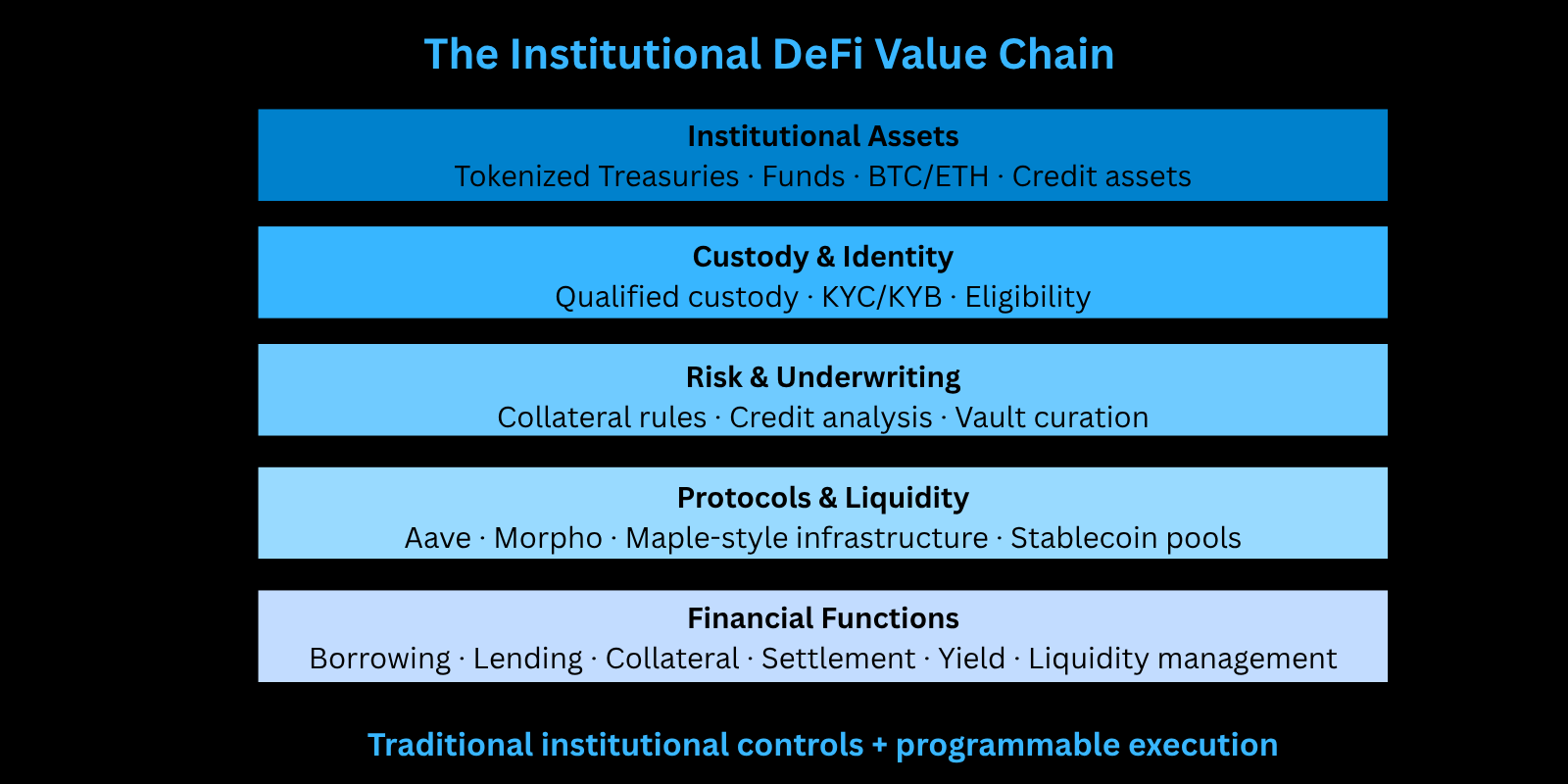
This is also why focusing exclusively on protocols may become increasingly misleading.
The important question is not whether Aave defeats Morpho or whether decentralized lending replaces a particular bank. It is who performs each financial function best.
Those functions can increasingly be separated and recombined.
The result is a new competitive landscape in which firms can capture individual layers of the financial value chain without owning the entire transaction.
That is one reason digital financial infrastructure may ultimately prove more disruptive than any individual cryptoasset. It changes the boundaries of financial institutions.
Calling this emerging market "institutional DeFi" may eventually become unnecessary.
If programmable lending, automated collateral management, stablecoin settlement and tokenized assets become normal components of financial markets, the distinction between DeFi and finance begins to blur.
The underlying mechanisms remain important.
But institutions are increasingly adding the elements that large-scale finance requires:
That combination bears little resemblance to the yield-farming boom that defined DeFi's public image five years ago. And that may be precisely why it is more consequential.
The next phase of decentralized finance may not arrive with another speculative token cycle.
It may arrive quietly, as tokenized assets become collateral, custodians connect clients to lending protocols, asset managers curate on-chain credit, compliance becomes programmable and stablecoins provide liquidity across markets.
At that point, DeFi stops looking like an alternative financial system. It starts becoming part of the infrastructure of the existing one.
Continue the Analysis
Institutional DeFi makes tokenized assets useful as collateral—but functioning markets still depend on liquidity beyond issuance.
Next: Tokenized Assets and Secondary-Market Liquidity
October 12, 2026
11 minutes