
March 1, 2026
3 minutes

November 4, 2026
10 minutes

For much of their history, stablecoins have been a relatively concentrated business. Tether's USDT and Circle's USDC became the dominant digital dollars, supported by extensive exchange integrations, deep trading liquidity, and growing adoption across blockchain networks. New entrants emerged, but few threatened the established hierarchy.
That structure is beginning to change—not necessarily in the distribution of market share, but in the number and variety of institutions competing to shape the market.
Banks are developing digital representations of deposits. Payment networks are building infrastructure that connects conventional financial systems with blockchain-based settlement. Fintech companies are introducing stablecoins into existing customer relationships, while specialized issuers are pursuing different regulatory models, distribution partnerships, and institutional use cases.
The result is an increasingly complex market in which the competitive contest extends beyond the stablecoin itself.
The emerging question is not simply which stablecoin will become the largest. It is who will control the networks, customers, and infrastructure through which digital dollars move.
Despite the expanding field of participants, stablecoin market capitalization remains heavily concentrated.
According to DefiLlama, the total stablecoin market stood at approximately $293.8 billion on November 3, 2026. USDT accounted for roughly 61% of the total, while USDT and USDC together represented approximately 85%. That concentration illustrates the considerable advantages accumulated by the established issuers.
Stablecoins depend on more than reserve backing and the ability to maintain a dollar peg. Their usefulness also depends on liquidity, exchange listings, redemption arrangements, blockchain availability, and acceptance by counterparties. These characteristics reinforce one another: widespread availability encourages adoption, while adoption attracts additional integrations and liquidity.
An issuer entering the market must therefore compete against established networks, not merely offer another dollar-backed token. Yet concentration in circulating supply does not necessarily reveal the full extent of competitive activity.
New issuers may target particular customer groups, institutional workflows, or payment corridors rather than the broader cryptocurrency trading market. Their success may depend on the transaction volume or commercial relationships they establish rather than their share of aggregate stablecoin supply.
This suggests two developments occurring simultaneously. The largest stablecoins are retaining their scale advantages, while the market surrounding them is becoming more specialized and competitive.
The expansion of stablecoin issuance reflects the emergence of competing strategies for building digital-dollar businesses.
Tether and Circle developed their positions through broad circulation and integration into cryptocurrency markets, although their respective institutional strategies and distribution networks have evolved considerably.
Newer competitors increasingly begin with a more defined commercial proposition.
Ripple's RLUSD, for example, is positioned for institutional payments, liquidity management, trading, and capital-markets applications. Rather than relying solely on retail trading demand, Ripple is integrating the stablecoin with its broader institutional payments and digital-asset infrastructure.
Paxos has pursued a different strategy through USDG and the Global Dollar Network. The model emphasizes partnerships with exchanges, wallets, fintech companies, and other distributors, including an economic framework designed to reward participating businesses for expanding the network.
By July 2026, the Global Dollar Network reported more than 150 partners and over $3 billion in USDG circulation. The initiative demonstrates how stablecoin competition can extend into the economics of distribution itself.
These approaches reveal a market moving beyond the proposition that one broadly available stablecoin must serve every purpose.
Different participants may place different values on regulatory status, redemption access, treasury integration, liquidity arrangements, or existing commercial relationships. For institutional users, choosing a stablecoin is increasingly a decision about an entire service ecosystem rather than simply selecting a token.
The emerging stablecoin market is not a contest among identical businesses. Although participants may compete for overlapping institutional relationships and transaction activity, they are pursuing different strategies for capturing value from the adoption of digital dollars.
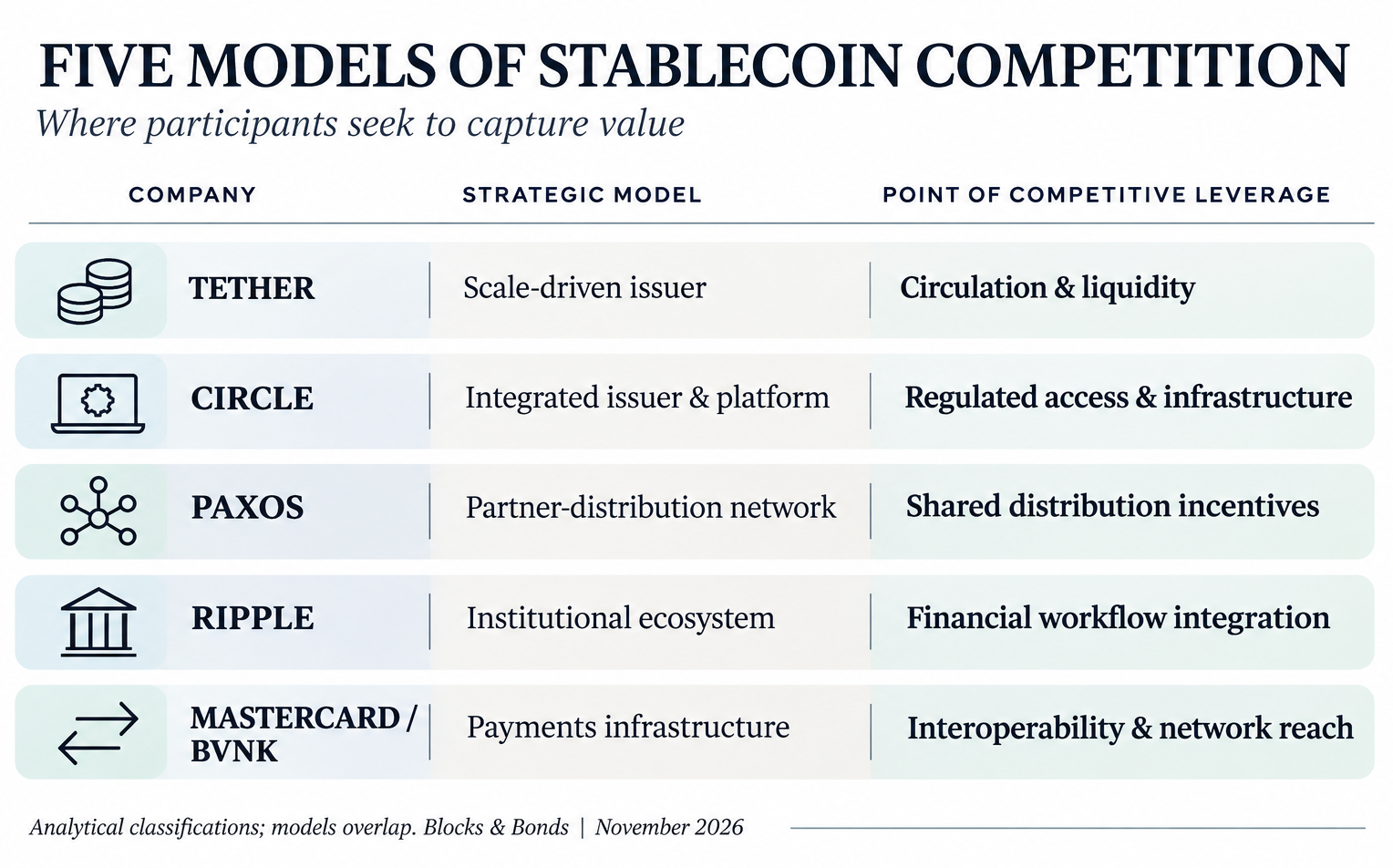
Five companies illustrate the range of approaches.
Tether: Scale and liquidity. Tether represents the incumbent circulation model. USDT's extensive adoption across exchanges, trading platforms, and blockchain networks provides a considerable advantage in liquidity and acceptance. Its economics are also closely connected to the income generated by assets backing circulating tokens. In October 2026, Tether reported $4.5 billion in net operating profit for the year's first three quarters, with U.S. Treasury bills and reverse repurchase agreements providing most of that income. Its competitive position depends heavily on maintaining circulation, liquidity, and confidence in redemption.
Circle: Regulated issuance and integrated financial infrastructure. Circle has built its position around USDC, regulatory alignment, and institutional accessibility. Increasingly, however, it is extending beyond issuance through the Circle Payments Network, digital-asset services, and blockchain infrastructure. Circle's strategy seeks to reinforce USDC circulation through a broader platform of applications and financial connectivity. Although reserve income remains its principal revenue source, the company is positioning itself to participate in more of the stablecoin value chain.
Paxos: Partnership-driven distribution. Paxos offers an alternative approach through USDG and the Global Dollar Network. Rather than treating distribution entirely as a service purchased by the issuer, the network shares economic rewards with participating businesses that help expand stablecoin adoption. The model is designed to align the incentives of issuers, exchanges, fintech platforms, and other distributors. Its success depends not simply on issuing a credible dollar token, but on building a network of commercially motivated partners.
Ripple: Institutional utility and ecosystem integration. Ripple approaches the market through RLUSD and its existing institutional financial infrastructure. The stablecoin is designed to support payments, trading, treasury operations, collateral, and tokenized-asset settlement. Its strategic proposition is that a digital dollar becomes more useful when embedded in an established ecosystem of financial services. Distribution therefore depends partly on the institutional relationships and infrastructure surrounding the token.
Mastercard/BVNK: Infrastructure and payment orchestration. Mastercard's acquisition of BVNK and the launch of its Global Money Platform illustrate a fundamentally different model. Rather than depending on the circulation of one proprietary stablecoin, the platform connects fiat currencies, stablecoins, conversion services, cards, and payment networks through integrated infrastructure. Its commercial opportunity lies in making multiple forms of money accessible through existing financial relationships and payment workflows.
These five strategies are not mutually exclusive. Circle and Ripple increasingly offer infrastructure alongside their stablecoins, while payment-network operators may influence which issuers gain adoption through their platforms.
Nevertheless, they illustrate how competitive advantage is spreading across distinct layers of the market. Issuers compete for circulating balances, financial institutions compete for enterprise relationships, and infrastructure providers compete to become the systems through which transactions are executed.
The next phase of stablecoin competition may therefore involve different business models capturing different portions of the same transaction, rather than a single issuer capturing the entire opportunity.
Banks Are Entering the Market—But Not Always Through Stablecoins
Traditional financial institutions add another dimension to this competitive landscape.
Banks have several potential approaches to digital money. They can issue payment stablecoins through permitted structures, partner with existing issuers, integrate third-party stablecoins into customer services, or tokenize deposits already held within the banking system.
These approaches may employ similar blockchain infrastructure, but they are not economically or legally identical.
J.P. Morgan's JPM Coin, represented by the JPMD deposit token, illustrates the distinction. Made available to institutional clients on Base in November 2025 and subsequently expanded to Ethereum, JPM Coin represents commercial-bank deposit money in tokenized form. It is intended to support institutional payments, liquidity management, and settlement.
A tokenized deposit remains a claim associated with a banking relationship, whereas a payment stablecoin represents a claim against its issuer under a different legal and regulatory structure.
The distinction affects the nature of the holder's claim, access requirements, supervision, and potentially the range of counterparties able to transact.
Banks may therefore compete with stablecoin issuers without necessarily introducing directly comparable instruments.
For corporate treasury departments and institutional financial firms, tokenized deposits could provide a means of accessing blockchain-based settlement while preserving established banking relationships. Conventional stablecoins, meanwhile, may offer broader circulation and access to counterparties outside any individual banking network.
The market could consequently develop into overlapping systems of digital money rather than converging around a single type of dollar token.
Perhaps the most consequential shift is taking place at the distribution and infrastructure layers. Payment companies have begun treating stablecoins less as standalone cryptocurrency products and more as components of a broader payments architecture.
In August 2026, Mastercard completed its acquisition of stablecoin infrastructure provider BVNK. Two months later, the companies launched Mastercard Global Money Platform, combining fiat and stablecoin capabilities through a single application programming interface.
The service is designed to allow banks, fintechs, and enterprises to integrate digital accounts, conversion services, and payment capabilities without assembling every underlying technical and financial connection themselves.
Visa has pursued its own infrastructure strategy. In July 2026, it introduced the Visa Stablecoin Platform, offering financial institutions and payment providers a managed environment for stablecoin operations, initially centered on Open USD (OUSD).
Stripe, meanwhile, announced in September that OUSD would be supported across its products, including treasury, issuing, payouts, onramps, and payment acceptance.
These developments point toward a significant change in how stablecoins reach users.
A business using an integrated payments platform may not need to maintain its own blockchain infrastructure, establish relationships with multiple issuers, or manage liquidity across numerous networks. Instead, stablecoins can become an underlying settlement mechanism embedded within familiar financial products.
This creates an important competitive possibility: the platforms that determine which stablecoins are available, how transactions are routed, and how users access liquidity may accumulate considerable influence even without becoming dominant issuers themselves.
It also changes the competitive incentives of established issuers.
Circle, for example, has expanded beyond issuing USDC into managed payment infrastructure through its Circle Payments Network. The platform allows financial firms to access stablecoin settlement while Circle manages elements of the underlying digital-asset lifecycle.
Issuance, payment orchestration, liquidity management, and distribution are becoming increasingly interconnected businesses. The boundaries between stablecoin issuers and payment infrastructure providers may become less distinct as a result.
The regulatory environment is also reshaping the market.
The GENIUS Act, enacted in July 2025, established a federal framework for payment stablecoin issuance in the United States. On October 21, 2026, the Office of the Comptroller of the Currency issued its final implementing rule for institutions within its jurisdiction, with the rule and relevant statutory requirements scheduled to take effect January 18, 2027.
The framework addresses reserve assets, redemption, risk management, supervision, reporting, and the authorization of permitted issuers.
Greater regulatory clarity may make stablecoins more attractive to financial institutions and enterprise customers that previously faced uncertainty over the legal treatment of digital-dollar products.
It can also create clearer pathways for new institutional participants. But regulatory standardization should not be confused with a guarantee of broader competition.
Compliance obligations, operational requirements, reserve management, and supervisory expectations introduce costs. Large institutions may be better equipped to absorb those costs, while smaller issuers could become increasingly dependent on regulated service providers and established distribution platforms.
The market could become more crowded with authorized issuers while simultaneously concentrating economic power among firms that possess the necessary customer relationships, liquidity, and infrastructure.
The outcome will depend partly on how effectively the regulatory framework enables competition among different institutional models.
A growing number of stablecoins, bank-issued instruments, and payment platforms does not automatically produce a more efficient financial system.
Fragmentation may introduce new operational complexity.
Different digital-dollar instruments can operate across different blockchains, depend on different redemption mechanisms, and impose different eligibility requirements. Liquidity may be distributed across networks or confined to particular institutions and trading venues.
For a corporate treasury operation, the practical issue is not simply whether a stablecoin can settle a transaction quickly.
The institution must also determine whether the recipient can accept the instrument, whether conversion is necessary, what the transaction costs, and how the movement of funds will be reconciled with existing financial systems.
A payment that settles in seconds on a blockchain can still encounter delays or expense when converted into usable bank money.
These challenges help explain the growing strategic importance of interoperability providers, liquidity services, and payment orchestration platforms. The more fragmented the underlying market becomes, the greater the potential value of infrastructure that can connect its components.
There is, however, a competing possibility. If a small number of large platforms become the primary gateways between issuers and users, the industry may reproduce familiar forms of financial intermediation on new technological rails.
Competition among digital-dollar instruments would then coexist with concentration among the companies providing access to them.
Stablecoin issuers have historically attracted attention because of the potential economics of reserve-backed issuance. An issuer holding substantial dollar reserves can earn income from the assets supporting its outstanding tokens, subject to operating costs, distribution arrangements, and regulatory requirements.
As competition increases, however, reserve economics may need to be shared with the businesses responsible for acquiring customers and generating transaction activity.
Distribution partners can demand better commercial terms. Payment providers can charge for integration, conversion, transaction processing, or access to customer networks. Infrastructure companies can build recurring revenue around compliance, treasury management, and interoperability.
A firm may therefore capture meaningful economic value from stablecoin adoption without issuing a stablecoin of its own.
The emerging competitive landscape contains several potential sources of advantage:
These functions overlap, and leading participants increasingly operate across more than one category.
Consequently, market capitalization alone may become an incomplete measure of competitive influence. Transaction activity, integration depth, distribution reach, liquidity quality, and economics retained across the value chain will all matter.
For financial institutions, the expansion of stablecoin models creates additional choices, but it also complicates decisions about technology, counterparties, and long-term infrastructure.
Selecting a digital-dollar provider is no longer simply a question of choosing between USDT and USDC. Institutions must determine which combination of issuers, networks, intermediaries, and financial services best supports their operating requirements.
Four considerations are particularly important.
1. Evaluate the entire transaction, not just the stablecoin.
A stablecoin may provide rapid blockchain settlement without delivering equivalent improvements across the complete payment process. Conversion costs, banking access, compliance requirements, redemption procedures, and reconciliation can affect the ultimate efficiency of a transaction. Institutions should assess the full movement of funds, from origination through final receipt in a usable currency.
2. Distinguish issuer risk from infrastructure dependency.
An institution may use a highly regulated stablecoin while remaining dependent on intermediaries for custody, liquidity, payment routing, and redemption access. The soundness of the issuer does not eliminate the operational and counterparty risks associated with these surrounding services. Procurement and risk management frameworks need to evaluate each critical relationship separately.
3. Preserve flexibility across issuers and networks.
The emergence of competing models creates uncertainty about which stablecoins and payment platforms will achieve lasting adoption. Institutions that build tightly around a single proprietary system could face switching costs or restricted access to alternative networks. Interoperability, portable integrations, and clear exit arrangements may therefore become valuable strategic requirements.
4. Determine where the institution intends to capture value.
For banks and payment companies, stablecoins can represent competing products, complementary infrastructure, or new sources of service revenue. A bank might issue its own digital instrument, distribute a third-party stablecoin, provide custody and redemption services, or integrate stablecoin settlement into existing client relationships.
The appropriate strategy depends on the institution's customer base, regulatory position, technical capabilities, and commercial objectives. Participating in the stablecoin economy does not necessarily require becoming a stablecoin issuer.
Taken together, these considerations suggest that institutional adoption will increasingly become an exercise in financial architecture rather than token selection.
The institutions best positioned to benefit may not be those that commit earliest to a particular stablecoin. They may be those that develop the flexibility to use different digital-money instruments while preserving control over customer relationships, liquidity, risk, and operating infrastructure.
The stablecoin market is not yet fragmented in the conventional sense of market share. The largest issuers remain dominant, supported by powerful liquidity and network effects.
But the business of delivering digital dollars is becoming more distributed across financial institutions, payment networks, infrastructure providers, and platforms serving distinct customer groups.
This creates a market that may become simultaneously more competitive and more interconnected.
The central uncertainty is whether new entrants will substantially reduce the dominance of established stablecoins or develop profitable businesses alongside them, often relying on existing digital-dollar liquidity.
A second uncertainty is whether interoperability will produce an open, competitive environment or encourage the emergence of new financial gatekeepers.
For institutions evaluating their digital-asset strategies, these questions have practical consequences. Stablecoin adoption should not be assessed only through the selection of an issuer or blockchain. It requires consideration of redemption, distribution, counterparties, regulatory exposure, and integration with existing financial operations.
The next phase of the stablecoin market may not be defined by the emergence of a single new digital dollar capable of displacing USDT or USDC.
It may instead be defined by the institutions that make competing digital dollars useful, accessible, and interchangeable across the global financial system.